Ca 1450: Florence - Triumphs and civic processions
1. Introduction
This study is a further step in defining the beginning of the spread in Florence, in the first half of the fifteenth century, of triumphal motifs as new fashions in the demonstrations and decorations of various products of the minor arts. Previously I have written notes on birth trays, wedding chests, and the Triumphi of Petrarch (1). At the origin of these studies I proposed as my main aim finding in objects of the types mentioned possible points for giving origin in Florence also to the fashion for naibi a trionfi, or playing cards with the addition to the common deck of a series not well defined of special cards, which gave rise to the tarot. (2) The initial intention was was scarcely comforted by the results, which showed that the fashion for those objects usually occurred after the new playing cards came into use.
It remains for me to consider other products, as well as special events, which could potentially affect the birth of those special cards. The spirit of this ongoing research has understandably changed and is getting closer to the formation of a prejudice, that the triumphal motifs entered playing cards before the other fashions, and then in an independent manner so as not to justify a deepening of this research; it would not be possible to interpret the origin of a given phenomenon as caused by what happened in related fields ... later.
While I have described in the past new fifteenth century documents useful for the history of playing cards (3), in these cases, the study does not extend to the search for original documents that could shed new light on the issues, but at its basis is placed an analysis of work published on the events in question. In examining the copious literature,
____________
1. http://www.naibi.net/ 5/11, 5/17, 5/21.
2. http://www.naibi.net/A/518-TRIONF1450-Z.pdf
3. F. Pratesi, Giochi di carte nella repubblica fiorentina. Ariccia 2016.
2
I will use, even more than usual, selections with drastic cuts, bearing in mind the importance of the various contributions in view of the specific underlying goal of this research, very peculiar and limited.
I have not utilized the numerous and repetitive discussions on these issues that have accumulated recently on the Internet, because they usually do not provide new elements. I can, however, acknowledge that many of the topics that will be introduced below have been widely discussed in some web pages: I can mention one name for all, Huck in the Researcher's Study of a major forum on tarot cards (4). Using this address one can find countless notices, abundantly commented upon, much more numerous, detailed and repeated more times than I can write here.
2. Triumphal events.
In the study of artistic and literary triumphs/tarot advanced recurrently have been hints of their origin in the triumphal displays that took place in the main Italian towns during the late Middle Ages and early Renaissance; for a broad illustration of the theme one can refer to a book regarded as a pioneer in the field (5). Under the term “triumphant event” fall, however, very different events; a first distinction can be seen between individual events - such as the triumphal entry into the city of a personage to whom a solemn welcome is dedicated - and ritual processions repeated at regular intervals, always with special solemnity.
To begin the review it is therefore necessary to restrict the scope of triumphal events and to distinguish the various types. For a convenient subdivision we can refer to a study by Antonio Pinelli, Feste e trionfi [celebrations and triumphs], among the most cited in this regard (6).
___________But since real triumphs do not interest us as much in themselves as for the imaginary ones they suggest, it can be useful, to better analyze them, to outline a series of subdivisions based on contents
4. viewforum.php?f=11.
5. G. Moakley, The tarot cards painted by Bonifazio Bembo. New York 1966.
6. S. Settis (ed.), Memoria dell’antico nell’arte italiana. Vol. 2, I generi e i temi ritrovati. Torino 1985, pp. 281-350.
3
As we see, the typologies sought are already listed separately in the four types of theater shows, carnival parades and the like, triumphs reproduced from ancient times, and triumphs bestowed on living personages. The same author warns that a mixed type of events must also be considered, in which, that is, in order to frame a given event, more than one of the four types identified is required.and destination. Essentially the chronicles describe four different types of triumphal ceremonies:
1) theatrical performances and courtly pomp that dramatize the Triumphs of Petrarch, more or less faithfully and completely, often mixing them with other allegorical ideas;
2) the processions set up during Carnival or other festive occasions, where more or less conscious reminiscences probably remain of the old triumphal ritual, to which sometimes are added, in the humanistic age, allegorical floats and parades programmatically inspired by Roman models;
3) depictions of a real ancient triumph, more or less imaginatively reconstructed as part of city or court festivals;
4) triumphs paying tribute to a victorious general, or at least to an eminent person, who makes his "grand entrance" in the city.
One can easily understand that within the four groups mentioned further subdivisions can be introduced, so as to identify the specific type with higher precision. If we choose Florence as a reference, we can use the setting by Paola Ventrone, inspired mainly by the theater but extending its scope to aspects, somehow connected, that fall fully within our interests.
4An acquisition central to the research is the finding that, in fifteenth-century Florence, four different types of 'religious performance’ coexisted, employing as many different performative languages to carry out their tasks: the celebration of the Baptist, by which the ruling class propagated the appearance of a republic in harmonious concord and ideally perfect; the procession of the Magi, which allowed the main members of the establishment to assert their preeminence in the streets, flaunting regal pomp otherwise politically unacceptable outside the time of the festival; the festivals of Oltrarno, who wanted to nourish the faith of believers creating an imagination of paradise through its visualization by means of scenic Brunelleschi machines; sacred depiction properly named, which was a real form of 'civic theater' aimed at the education of the Optimus civis and the construction of consensus. In particular, the latter two were also proposed as a complementary binary
It is noteworthy that in the citation, various types of religious display are distinguished, rather than - as we are looking for here - those related to the triumphs; yet many aspects considered in the quotation end up returning to our field of investigation. In summary, they would be the celebrations of St. John, the procession of the Magi, the Oltrarno festivals, and sacred representations true and proper. Within the four cases it remains to verify how much and what their triumphant character was. In the last type, organized primarily for educational purposes of more lasting influence, the triumphal character can practically be considered non-existent.system for the 'building' of citizens (in both the etymological and figurative sense): one, showing paradise as the ultimate prize of the deserving faithful; the other, showing them the way, the 'course of action' to follow to reach that goal. (7)
As for the Oltrarno festivals, their triumphal character is, where appropriate, typically religious; somehow it is always faith that triumphs and the viewer witnesses ingenious depictions that deeply catch his attention, and his memory, with scenic surprises, accompanied by thunder and as a rule, sudden artificial flashes and unpredictable abrupt changes in scene. In principle, even some of the personages of the first or second level in these depictions may serve our purposes for reconstructing sequences of "figures" comparable with the playing cards added to the common deck; however, the confirmation of such hypotheses has not been found, and thus we neglect the Oltrarno festivals, along with the sacred depictions. In consequence we find ourselves fully involved with the celebrations of St. John and the Magi.
3. Public processions of triumphal carts.
The idea of a public procession is already stimulating for our purposes, always bearing in mind that the goal is to explain the sequence of triumphal cards added to the common deck of playing cards. The Triumphi of Petrarch were an important precedent, albeit on a reduced scale; for us, the main feature of the poem was that every triumph overcame the previous one. We cannot be surprised by the suggestion made,
_________________
7. P. Ventrone, Teatro e sacra rappresentazione a Firenze nel Rinascimento. Firenze 2016, p. XV.
5
among the first, by Werner Weisbach (8), that at the origin of the poem there were in fact public processions, in which the personages typically advance so that each takes the place of the previous one. For triumphal cards the basic idea is always that of a progression; so processions are welcomed that can make us glimpse a working mechanism that can, at least in principle, also be the source of that new type of playing cards; frequently recalled in this respect is the old book by Gertrude Moakley already mentioned.
We can discard as well (because of the need to support the analogy indicated) all depictions confined to a theater stage, however rudimentary, or stationary tableaux vivants, for which I can refer to the ample specific monograph of Philine Helas (9); However, the passage from this source on tableaux vivants in motion is not necessarily irregular and justly connected to the type that was sometimes in the processions. Clearly, they must be distinguished from a wagon that passes through the city with figures depicting, for example, a biblical episode; we need a whole series of floats that parade one after another.
The Triumphi can be recalled again because many depictions on cassoni and in illuminated manuscripts present precisely the triumphs of Petrarch, with carts pulled by various animals and accompanied by followers more or less consistent with the main subject. They are also images reproduced in the triumphal chariot processions that parade through the city. For our tarot, there would thus be an increase in their number, which already would be no mean feat.
Examination of the studies related to this subject soon brings us to the conclusion that all these famous triumphal parades of floats really happened; however, all the triumphal parades that are known from the Renaissance, with their triumphant personages standing on high carts, richly decorated - drawn by animals of various species and easily advancing through the movement of their wheels - do not serve our purpose, and we can neglect everything as greatly posterior to the introduction of the triumphs in playing cards. In short, we must go back in time, when the triumphal parades existed but had not yet taken the form of a parade of floats with wheels. What was
___________
8. W. Weisbach, Repertorium für Kunstwissenschaft, 26 (1903/04) 226-287.
9. Ph. Helas, Lebende Bilder in der italienischen Festkultur des 15. Jahrhunderts. Berlin 1999.
6
then in place of the triumphal carts? There were "buildings", wooden scaffoldings abundantly coated and decorated, transportable by a group of carriers; these are structures that we will meet later.
4. Triumphal entrances
A particular kind of triumphal procession at the city level, often referred to by the Latin term adventus, is the solemn entry of a king or a man who thus takes possession in a solemn manner of the city government. These marches will have testimonies from many cities, and not only Italian ones; indeed, going back in time, there are probably more traces in Burgundy, where they were habitual in the mid- fourteenth century, before making frequent appearances in Italy. (10)
We are interested particularly in Florence and here we encounter a rather curious situation. In particular, one might immediately jump to another topic and close the issue by stating that Florence had not been introduced to customs of this kind before 1440, for us given as the limit of the search. Receptions and festive jubilation for political or military successes involving the entire city were more or less frequent in Florence, but it does not appear that those displays of the people were organized and planned in advance using specialized workers coordinated by persons officially responsible for the enterprise (functions that the participants had for the celebrations of Saint John, and the Society of the Magi had for the related procession).
There remains, however, the fact of a very important that in a great triumphal event, which did not happen in Florence but in Naples, Florentines were coincidentally protagonists. In the famous procession that in 1443 accompanied Alfonso of Aragon into the city, after having driven out Anjou, it was the "Florentine nation" that organized the main part of the event. It is unlikely that the Florentines had acted only as bankers, financing the enterprise without taking care of the details. We have to think rather than the staging of the event itself corresponded to known superior technical ability of the Florentine work force and artists. It is enough to reflect on the complexity of Fortuna standing on a large golden sphere held
____________
10. P. Johanek, A. Lampen (ed.), Adventus. Köln etc. 2009
7
by an angel, or Caesar on a rotating terrestrial sphere, to understand that they needed technicians very experienced in machine building; Helas in the book cited even recalls the skills of Filippo Brunelleschi and Paolo dal Pozzo Toscanelli; although the circumstances have been widely studied and repeatedly discussed, details about those executing them are unknown.
The technical skills required ranged from the highest organized levels to the most minute operations the particular stagings; porters and extras could be found locally, but for the coordination and success of the whole the mobilization of Florentine experts was needed. Before us is then the following dilemma: to the Florentines that prepared and developed the details of the ceremony, will their generic skills such as decorators and expert builders of all types of machines be enough, or could they use directly their own specific experience in the field? The problematic fact is that for us there is not found in Florence, before 1443, an activity specific to that genre we call triumphally organized, unless leading back to the processions of the annual celebrations of the patron and the magi, which we will meet again later.
Nevertheless it appears significant that the subjects chosen by the Florentines for the triumphal procession in Naples in 1443 were the seven virtues (six mounted and Justice on a rich edifice), Fortune, and Caesar as emperor, personages who in one way or another are certainly part of the csequence preserved in the cards. Then it would be for us especially to be analyzed, and possibly verify whether similar figures could already be present in Florence three years earlier in those "naibi a trionfi" that were commissioned by Giusto Giusti.
5. Triumphs to victors
In parallel to the triumphal processions of the adventus type commented on so far, we have testimonies of the more traditional triumphs organized to celebrate a general who emerged victorious from a war or major battle. These episodes are clearly not programmable in advance and recall, perhaps more closely than all the other events, the triumphs that were solemnly celebrated in ancient Rome, again on the occasion of military victories.
8
In Florence there were several times popular events improvised for various occasions, including precisely also battles won. Other opportunities to celebrate in the streets of Florence were not lacking and were mainly related to the passage of famous people in the city: popes, emperors, kings, but also foreign embassies. The most sensational was probably the arrival in the city in 1439 of the various groups of prelates engaged in the Council of Ferrara, who moved to Florence to avoid an epidemic of plague. There was certainly no need for masked figures, if richly and exotically dressed patriarchs and Eastern theologians entered the city in procession, according to their custom; along with the religious personages came none other than the Byzantine emperor John VIII Palaeologus. For the almost impromptu character of these small town hospitality events it seems of little use to research here particular sequences of "figures" to put in relation with the triumphs-tarot.
Of true and proper triumphs officially organized as an honor given to a victorious leader or a visiting foreign monarch, I have not found any of significance in Florence for the time period; an example would be the procession that followed in 1419 Pope Martin V, who walked on a special timber walkway, built for the occasion, all the way from the provisional papacy of Santa Maria Novella to the cathedral, but it is not accompanied by allegorical figures. I can then look for other examples, which were actually celebrated: one can in fact find also in Florence rather similar events, instead of being quite odd, like those above, on the contrary were even seen recurring annually: the celebration of the Baptist and the procession of the Magi; these are the events that will be considered below.
6. Festivals of St. John
The festivities in honor of the patron saint, St. John the Baptist, were the most captivating and solemn at the city level, and besides the day of the anniversary, June 24, it also occupied several neighboring days; the duration of the celebration varied in the course of time to more than a week, but we can limit ourselves to the main events, which usually occupied on the day of the anniversary and the evenng before. A detailed reconstruction of the events traditionally repeated has been
9
compiled by Richard Trexler (11), but for some particulars the books books on the feast of St. John written by Gaetano Cambiagi (Fig. 1) (12), Cesare Guasti (13) and Luigi Gori (14) can also be useful (with the third one the most recent, such as to be dedicated to ... Benito Mussolini).

Figure 1 – First publication on the festival of Saint John
_______________
9. R. C. Trexler, Public Life in Renaissance Florence. New York etc. 1980, pp. 240-278.
10. G. Cambiagi, Memorie istoriche riguardanti le feste solite farsi in Firenze per la natività di San Gio. Batista. Firenze 1766 (reprinted, Firenze 1985).
C. Guasti, Le feste di San Giovanni Batista in Firenze. Firenze 1884.
L. Gori, Le feste fiorentine attraverso i secoli. Le feste per San Giovanni. Firenze 1928
10
We can start with the evening before and outline the main events; in the morning the show began, that is, the external exposition in the shops of the most valuable manufactures and the most precious objects: the flower of flowers in all areas of Florentine production was presented to the eyes of passers-by, including rarities preserved jealously and that would not have been exhibited at any other time. In the eyes of a stranger who saw that exhibition for the first time, the display was certainly memorable and obtained a further propaganda effect in favor of the already renowned Florentine manufactures.
After this public display that validated material wealth followed, almost in the manner of purification, the procession of church people. Anyone who does not know the environment will be surprised by different aspects of that procession, starting with the number of participants: it required the participation of two members representing each of the numerous congregations of the regular clergy and also a large number of representatives of the secular clergy; a notice reported by Trexler for 1394 shows 380 members of religious orders and 132 from the secular clergy; those two such high numbers will probably change little for the years of our interest. Each participating group carried the most precious relics of his church or monastery and this was done suitably under cover of fine canopies that distinguished the entire procession.
In the evening, in contrast, paraded the banners of the city, with the offering brought to the Baptistery. Typically representatives of the armed companies of citizens had to participate, each under its own banner, arranged with the older members in front and the younger behind; the presence of two men per family was formally requested, with fines for those absent.
The most important events, at least from the civic point of view, took place on the day of the festival: in the morning, the procession of Saint John and in the afternoon the Palio. The Palio was a race by horses and jockeys from all sides, with the aim of winning the prestigious award. The race took place in lines, crossing the city from west to east. The Florentines were captivated by the show, much anticipated, but they did not have an active and direct participation of the kind that we still know today through the streets of Siena.
11
7. Procession of St. John
For our purposes, the most interesting part of the celebrations of the patron saint is clearly the solemn procession that followed the morning offerings. The St John's procession was nominally dedicated to the patron saint of the city, but what was honored in this case was especially the Florentine republic. All the "autonomous and subject communities" were required to participate with the candles or the Palio, which were first gathered in the Piazza dei Signori and then taken in procession. In a substantial proportion of cases, the participation with the offering of the candle was the only tribute that the ruling required of a given town (in other cases the charges could be much more burdensome). A number of these candles were not simple tapers, but understood as taller and more massive than average; here one went above [i.e. high on a vehicle, Franco tells me] and the candle, thus finely decorated, in some cases was raised high above the wooden scaffolding and painted paper; appropriate descriptions (and images that have to be considered as only indicative, as they correspond to [similar items of] much later times) are also found in the book by Gori already mentioned.
There were also painters, usually lower level, who specialized precisely in the decoration of the candles (16); on the production of candles and of wax, in Florence of the epoch, for which one can usefully consult a brief study by Paola Giorgi (17).Those that Goro Dati called Towers [Torre] were deployed on the morning of June 24 in the Piazza of the Signori, other candles that were not so big and tall, some with real wax to burn, others of paper maché and wood, painted in many guises and so heavy that no one could carry them by hand, were placed on carts, having, for the most part, the form of turrets, and those of the Castles subject to the rule of the Republic, who were required to send them. (15)
Along with the candles of the festival of St. John existed the palios [palii, embroidered tapestries], with figures and extraordinary decorations, presented among the offerings and then taken in procession and left to the town, which preserved them, along with the candles, in the Baptistery. These palios were hangings of fine and richly decorated fabrics; to understand what they were we can exploit the survival of the
________________
15. L. Gori, Le feste etc., p. 72.
16. W. Jacobsen, Die Maler von Florenz zu Beginn der Renaissance. München-Berlin 2001, pp. 55-56.
17. P. Pastori (ed.), La festa di San Giovanni. Firenze 1997, pp. 70-79.
12
palio of Siena, destined to the winner. The palios, like the candles, formed a kind of forced offering by different municipalities under Florentine dominion and also by the lords of nominally independent territories that in some way were required to pay tribute to Florentine dominion; their numbers were quite high and not constant; in particular, with the passage of time the offering of the palios became gradually more prevalent than that of the candles. After the offering to the Signoria, the candles and the palios were carried in procession.
The procession of the representatives of the various cities and castles moved along a traditional city itinerary.After the act of submission to the Signoria by the lands of the domain (significantly the only gesture of homage to the political authorities, since all the processions intended to glorify the patron saint), the crowded procession of the governing bodies, with all their own distinct symbols, which was divided into distinct segments, moved from the square: the procession opened with the Captains of the Guelph Party, preceded by their banner, and the Florentine knights, along with the ambassadors and foreign knights; there followed the Palio and the candles of wood and the torches and special offerings of candles by the citizens of villages kept in oblation; Then the Lords of the Mint with their wagon (a particularly elaborate candle), accompanied by the masters of the Arts of Calimala and Changers (directly responsible for the organization of the festival), each bearing a wax torch; then the Priors and the Colleges with the Podestà, Captain and Executor of the ordinances of justice together, for greater solemnity, with trumpets and fifes; last went to the offerings the racehorses [what barberi means, Franco tells me] of the Palio, the weavers of Flemish and Bramantine wool living in Florence, and twelve prisoners of the Stinche prison, freed by mercy "to the honor of St. John". (18)
Of particular note is the participation at the festival of a variable number of "buildings", moveable wooden structures, often with a stageOf the itinerary of the procession there are no precise indications, but from some data it may be assumed that it was from Santa Maria del Fiore by the Corso Adimari (Via Calzaioli), Piazza della Signoria, Via de Gondi, Piazza San Firenze e Apollinare, Badia, Via del Proconsolo, Canto dei Pazzi, Santa Maria in Campo, Duomo NW side, returning by San Giovanni and Santa Maria del Fiore. (19)
______________
18. P. Ventrone, Annali di Storia di Firenze, II (2007): <http://www.dssg.unifi.it/SDF/annali/annali2007.htm>
19. L. Gori, Le feste etc., p. 24.
13
on which were placed some figures. According to Trexler the first evidence that we have - Gregorio Dati for the celebration of 1410 - is shortly after their introduction, which would have occurred with the initial participation of lay brotherhoods in the celebrations of the patron saint of Florence. On buildings in use at that time in Florence we can give the floor again to Paola Ventrone.
Unfortunately, we have little information on the details of the parade in the various years; we are interested in particular to know the number and type of buildings and their representations recited in front of the Signoria. We have a sufficiently precise list for 1454, as reproduced below, but the description is introduced precisely with the expression that in that "was changed the form of celebration", which leaves us in uncertainty as to what could be different in previous years that would be of interest for us. [Translator's note: since the Italian is archaic and a document, I give the original, with my attempt at a translation following.]As for the buildings, carried on the shoulders of porters and not dragged on wheels as would take place in the triumphal chariots of later years, they reveal multiple uses and conformations. In episodes with just a few characters, like the Annunciation that only included the presence of Gabriel, Mary and angels, carrying the set along the way until the perfunctory stop in front of the Signoria; in the more complex representations of drama, proceeded, however, as empty of appointed places, preceded or followed by sumptuous cavalcades whose protagonists came up on stage only at the time of the dramatic action, as in the case of Moses, the prophets, Octavian, Herod with the Magi, and so on. They could also have a multiple structure, as in the Templum Pacis [Temple of Peace], which depicted on the lower floor a temple surrounded by columns within which had to be hidden the stable of the Nativity, and on the top children dressed as angels probably intended to accompany the prophetic vision of the Tiburtine Sibyl, with the Virgin and Child in a cloud.
Another testimony details the technical consistency of these devices in the years neighboring the Antonine reform [that Antoninus, 1389-1459. https://en.wikipedia.org/wiki/Antoninus_of_Florence, Franco tells me]. In Roma thriumphans, composed by Flavio Biondo between 1457 and 1459, the Florentine festivals are likened to Roman triumphs and there is emphasized the artifice of 'trees' animated by children, which must have been a recurring theme in many buildings, both for choreographjc effect and for the astonishment evidently induced in the audience (20)
A dì 22.
_________________
- Nel principio mosse la Croce di Santa Maria del Fiore, con tutti i loro cherici fanciulli, e rieto a loro sei cantori.
20. P. Ventrone, Teatro etc., pp. 201-202.
14
(Of the 22.
- Secondo, le Compagnie di Jacopo cimatore e Nofri calzaiolo, con circa trenta fanciulli vestiti di bianco e angioletti.
- Terzo, Edifizio di San Michel Agnolo; al quale soprastava Iddio Padre in una nuvola: e in Piazza, al dirimpetto a’ Signori, fecero rappresentazione della battaglia Angelica, quando Lucifero fu co’ sua agnoli maladetti cacciato di cielo.
- Quarto, la Compagnia di ser Antonio e Piero di Mariano, con circa trenta fanciulli vestiti di bianco e agnoletti.
- Quinto, l’Edifizio di Adamo; che in Piazza fe rappresentazione di quando Iddio creò Adamo e poi Eva, fe loro il comandamento, e la loro disobbedienza, infino a cacciarli di Paradiso, con la tentazione prima del serpente, et altre appartenenze.
- Sesto, un Moísè a cavallo, con assai cavalleria di principali del popolo d’Israelle, ed altri.
- Settimo, l’Edifizio di Moisè; il quale in Piazza fe la rappresentazione di quando Iddio li diè la legge.
- Ottavo, più Profeti e Sibille, con Ermes e Trimegisto et altri Profetizzatori dell’incarnazione di Cristo.
- Nono, l’Edifizio dell’Annunziata; che fe la sua rappresentazione.
- Decimo, Ottaviano imperatore, con molta cavalleria, e con la Sibilla; per far rappresentazione quando la Sibilla li predisse doveva nascer Cristo, e mostrògli la Vergine in aria con Cristo in braccio. (...)
- Undecimo, Templum pacis, con 1’Edi-fizio della Natività, per fare la sua rappresentazione.
- Duodecimo, un magnifico e trionfal tempio per edifizio; nel qual tempio ottangolare ornato di sette Virtù intorno, e da oriente la Vergine con Cristo nato; e Erode intorno a detto tempio fe la sua rap-presentazione.
- Tredicesimo, tre Magi, con cavalleria di più di dugento cavalli ornati molto magnificamente, vennono a offerta a Cristo nato. Tralasciossi la Passione e Sepoltura, perché non parve che si convenisse a festa.
- Decimoquarto, una cavalleria di Pilato, ordinata in guardie del Sepolcro.
- Decimoquinto, l’Edi-fizio della Sepoltura, onde resuscitò Cristo.
- Decimosesto, l’Edifizio del Limbo, onde trasse i Santi Padri.
- Decimosettimo, l’Edifizio del Paradiso, dove messe detti Santi Padri.
- Decimottavo, gli Apostoli e le Marie che furon presenti all’Assunzione.
- Decimonono, l’Edifizio dell’Assunzione di Cristo, cioè quando salì al cielo.
- Ventesimo, cavalleria di tre Re, reine e damigelle e ninfe, con cani e altre appartenenze, al vivo.
- Ventune-simo, l’Edifizio del Vivo e del Morto.
- Vigesimosecondo, l’Edi-fizio del Giudizio, con barella de’ sepolcri, Paradiso, e Inferno; e sua rappresentazione, come per fede si crede sarà in fine de’ secoli.
- Tutti i sopraddetti Edifizi ferono sua rappresentazione in Piazza innanzi a’ Signori; e durarono infino alle 16 ore.
_____________
- First moves the Cross of Santa Maria del Fiore, with all its clergy children, and in behind their six singers.
20. P. Ventrone, Teatro etc., pp. 201-202.
.
14
- Second, the Companies of Jacopo the shearer and Nofri the cobbler, with about thirty children dressed in white and angels.
- Third, the Building of Saint Michael Angel, who was standing above God the Father in a cloud: and in the Piazza opposite to the Signoria, a depiction of the battle of the Angel was dones, when Lucifer with his accursed angels was kicked out of heaven.
- Fourth, the Company di ser Piero and Antonio Mariano, with about thirty children-angels dressed in white.
- Fifth, the Building of Adam; in the Piazza was depicted when God created Adam and then Eve, gave them the commandment, and their disobedience, also being expelled from Heaven, with the temptation of the snake before, and other things pertaining.
- Sixth, Moses on horseback, with much cavalry, the leaders of the people of Israel, and others.
- Seventh, the Building of Moses; which in the Piazza was representation of when God gave them the law.
- Eighth, most of the Prophets and Sibyls, with Hermes Trismegistus and other Prophetizers of the incarnation of Christ.
- Ninth, the Annunciation Building; and its representation.
- Tenth, Emperor Octavian, with much cavalry, and the Sibyl; to make representations when the Sibyl foretold them Christ was to be born, and depiction the Virgin with Christ in her arms in the air. (...)
- Eleventh, Templum Pacis, with the Building of the Nativity, to make its depiction.
- Twelfth, a magnificent triumphal temple edifice; in which the ornate octagonal temple, seven Virtues around, and from the east the Virgin with Christ was born; and Herod around said temple was its depiction.
- Thirteenth, the three Magi, with cavalry of more than two hundred horses decorated very beautifully, come to offer to the newborn Christ. Omitting the Passion and Burial, because it seemed inappropriate for the occasion.
- Fourteenth, a cavalry of Pilate, ordered to guard the Sepulcher.
- Fifteenth, the Edifice of Burial, where Christ was resurrected.
- Sixteenth, the Building of Limbo, from where the Holy Fathers were taken.
- Seventeenth, the Building of Paradise, where the Holy Fathers said Masses.
- Eighteenth, the Apostles and Mary who have been present at the Assumption.
- Nineteenth, the Building of the Assumption of Christ, that is, when he ascended to heaven.
- Twentieth, three cavalry, King, Queen and maidens and nymphs, with dogs and others pertaining, living.
- Twenty-first, the Building of the Living and the Dead.
- Twenty-second the Building of Judgment, with the float of the sepulchers, Heaven, and Hell; and its representation, as by faith we believe will be the end of the centuries.
- All the above mentioned buildings made their representations in the Piazza before the Signoria; and they lasted even to the 16th hour.) (21)
________________
21. C. Guasti, Le feste di San Giovanni... pp. 21-22.15
A series of twenty-two scenes ending in the Judgment surely will surely summon the attention of some tarot historian, but to find convincing associations for twenty-two figures looks anything but easy.
8. Procession of the Magi
There is a rich bibliography on the Magi, with views that extend from blind credulity to full disbelief. It is pleasing to read studies that can at least bring some disrepute to authors in certain circles, but not to condemn them to the stake as would definitely have occurred a few centuries ago. Many of the complex historical issues affect us only marginally. On the origins of the Magi and on their historical setting I can gladly defer to a small book that was published from an academic lecture held a few years ago by Antonio Panaino (22); those who wished to go deeper can find discussed the most unexpected information (e.g. for me to read that someone has associated the pulsar PSR 1913 + 16b with the sacred comet) and above all a wealth of references, including very old studies. A serious discussion is also found in various publications by Franco Cardini, again highly academic, among which I have used especially those of 1993 (23) and 2011 (24); the second publication also includes an interesting proposal to revive the festive celebration at the city level.
As for the involvement of the neighboring towns, the procession of the Magi had a much lesser appeal than that of Saint John; in this ceremony only the most prominent city families were to "triumph" on the occasion, i.e. in this case, to celebrate themselves, showing themselves worthy of honor and respect on the part of ordinary citizens. For those who could afford it, it was a unique opportunity to circumvent the sumptuary laws and showcase gaudy attires and jewels of great value. It seems that the first procession of this
____________
22. A. Panaino, I magi evangelici. Ravenna 2004.
23. F. Cardini, La stella e i re. Firenze 1993.
24. F. Cardini, Il giglio, la stella e tre corone. Firenze 2011.
16
kind took place in 1390, with Baldassarre degli Ubriachi [Trans. note: Italian for “of the Drunkards”] as a promoter.
The pinnacle of that synthesis between chivalric-courtly imagination and religious cerimoniality, which also characterized the Medicean Florence of the Republican Age, is the "festival of the Magi”, as defined in the sources: one of the the oldest attested pageants, although its origins are still not fully understood. It was first heard of in 1390 (1389 s.f. [Florentine dating]) when, according to the striking - and very plausible, although conjectural - hypothesis of Richard Trexler, the rich Florentine merchant and banker Baldassarre degli Ubriachi wanted to celebrate in honor of his namesake saint, in a particularly salient personal fortune.
A man exceptionally versatile and enterprising in his youth, Ubriachi had exercised the profession of money-changer, under the shadow of [i.e. protection of, Franco tells me] the Papal Court of Avignon; in consequence he then made a fine cursus honorum with Emperor Charles IV, by whom in 1369 he was honored with the title of Count Palatine with the right to legitimize his bastard children. (25)
In the conduct of the procession celebrating a fixed point, it seems that it has always been the convent of San Marco, even before those Observant Dominicans were transferred there who made it famous, if only thanks to Savonarola. Initially it formed the starting location and also that of the final arrival of the procession, stopping in front of the Baptistery, where the palace of King Herod had been built, and then went on to the Piazza of the Signori, then returning to San Marco.
___________________In December 1408 the Signoria stated that every year on the occasion of the Epiphany, the "Six of Merchandise" and the "Consuls of the Arts" were required to submit to the church of San Marco an oblation of wax Torchietti. As it is not known with documented certainty, it seems unwise to assume that the connection between Epiphany and the Church of San Marco was in fact made up of the ceremonial procession attested since 1390, and the details of the Signoria, which provided that making the tribute were the heads of the magistrates who presided over the economic and productive life of the city, he meant to read somehow the wise men in the key of "reason of merchandice". Gold, frankincense and myrrh, symbolic gifts at various levels, as we have seen were, among other things, goods. And the Magi, Patrons of anyone who was traveling, could not be, in a center like Florence, other than also the merchants. In 1417 the documents tell us with certainty that there had already formed a veritable "Compagnia de 'Magi'”, with the task of organizing every year the procession-show of the three kings through the city. (26)
25. P. Ventrone, Teatro etc.
26. F. Cardini, La stella etc., pp. 128-129.
17
The parade was enriched by the participation of many knights and the three wagons of the Magi, decorated with a wealth of products of Florentine manufacturers and fruits of the surrounding countryside, and all around accompanied on the journey by slaves dressed in oriental fashion. The wagons in most, or the buildings that were there, if they participated, were, however, much reduced in number.
The festival of the Magi was thus recurrently celebrated, but with variation in the magnificence of the celebrations, up to the extreme case of a complete suppression of the festival (to prevent possible related unrest) from 1419 to 1426, years that are in the period of our interest. The absence of celebrations in those years was partly offset by the amazing altarpiece that Gentile da Fabriano finished painting in 1423 for the Strozzi Chapel in Santa Trinita and which had great influence on some aspects of Florentine figurative art (understandably more on the minor works than on the masterpieces of the Renaissance).
The celebrations then continued with greater force until the intervention of the Medici, who came to extend the route of the procession, and then pass in front of their homes (which were in Via Larga even before they built the famous Palazzo) up to Herod's palace located then in the gardens of San Marco. For the wealth of attire the procession of the Magi long remained an important event and a great attraction for all citizens; only the most influential members could take part directly, but all citizens participated enthusiastically as spectators.
In the coming years, the Ludus Magorum left, in Florence, a deep and lasting impression, because the depiction of royalty, marked by that exquisitely gothic taste that Baldassarre had breathed following the Emperor and had assimilated impregnandone their ivory artifacts, remained impressed as much in the imagination of the ruling elite, as in that of the local community which drew, in turn, economic benefit and enjoyment from being involved in the organization of the event, whether paying for the artisanal work of its workshops, or enjoying the view.
____________
27. P. Ventrone, Teatro etc., p. 89.
18
On the composition of the procession we have information especially on the parade of knights, but some reports indicate the occasional presence of special personages and machines, in addition to the three carts of the Magi, but again much reduced in number.
9. Search for plausible associationsThe Company contributed to the festival of Saint John in 1428 with a retinue the main character of which was "one old man in white beard and clothed in gold brocade". Indeed, one gets the impression that the various processions that in Florence were held in the carnival period, then in early spring, thus the end of June for the festivities of patron John the Baptist, were now opportunities to show off scenes and allegories of various kinds, without direct reference (or in any case not with exclusive reference) to the festival that from time to time was solemnized. So also the procession of the Magi should not be focused only on them. At Epiphany of 1429 the stage of Herod the king had been erected in the Piazza of the Signoria while another stage was erected in Piazza San Marco for the Virgin and Child. In the afternoon there was the real cortege with about seven hundred people on horseback, among whom the magi and their companions, apparently members of the "Compagnia de 'Magi". However, various personages were also part of the procession, such as three giants, a "wild man", and a wagon with David who struck Goliath with a slingshot. (28)
Having summarized the civic events that in various ways and measures were characterized with triumphal motifs, we may review some aspects in the search for possible links with those triumphs that appeared, at least from 1440, but probably before, in playing cards.
The procession of Saint John, we have seen, was not a few personages or scenes with characters parading, but were the representatives of many communities proceeding one after another. It is understandable that those solemn processions must have respected an order of advancement in ranks, such that it could be put in relationship with the requirement necessary for playing cards whose hierarchical power had to be recognized immediately, before it was shown by special numbers of the order imprinted on the card. But in this case it is precisely the number of individuals making the two situations incomparable; in the processions of Saint John and the Magi hundreds of characters paraded; participants of those processions were in short too
______________
28. F. Cardini, La stella etc., p. 129.
19
numerous for any attempt at individual association, and eventually some homogeneous groups must be isolated that paraded together.
Some possibilities, also in these cases, remain open in searching for possible associations among groups of subjects and corresponding representations. Let us review the celebrations of St. John. We have to start the day before, but the two events in the morning do not appear useful elements: the exhibition was offered to the sight of passers-by of a very large number of valuable goods, but a sequence of the type sought could not exist for those - nor for the shops. even if somehow "triumphant". Some sequence could be made out for all the little bones of saints, virgins and martyrs, transported under the golden canopy of the religious procession, but even among those would not be easy to discern an ordered set, let alone a list ordered by value.
The most obvious and secure aspect is the presence in the evening procession of representatives of the sixteen separate urban districts in which the city was divided, four in each district, as follows: Santa Maria Novella: Viper, Unicorn, Red Lion, White Lion: San Giovanni: Gold Lion, Green Dragon, Keys, Vaio [grey fur of the Siberian squirrel, very fine, Franco tells me]; Santa Croce: Chariot, Ox , Black Lion, Wheel; Santo Spirito: Ladder, Shell, Ferza [a kind of whip, Franco tells me], Dragon. Clearly, only for the Florentines would it have been possible to identify a sequential order for all sixteen banners; the sixteen symbols corresponding to the names indicated above do not lend themselves at all to constituting an ordered scale of values. For the position in the procession of each banner there was an established order with the priorities to be respected; we do not know if it was fixed once and for all, or if it was changed more or less frequently, but we can imagine that it generated fierce debates.
We thus come to equating the number of subjects involved with the high cards in the deck of the triumphs of Marziano, which can appear as a considerable advance. Thinking about the triumphs of Marziano, the analogy is immediate and profound: the four quarters correspond to the four suits of the deck and the 4x4 banners to his divinities. It is noteworthy that in both cases there is a breakdown of sixteen elements into four groups, a similarly not in immediate numerical order from 1 to 16; neither of the two sequences presented per se as a clear ranking of power. The order had to be set out explicitly in the case of Marziano, and in the other from preliminary agreements among citizens. However, it remains very difficult to find
20
any association between the signs of the sixteen banners that advance in beautiful display in parades and the sixteen divinities of Marziano, or even sixteen other triumphal cards sometimes considered at the origin of the tarot.
As for the number of groups involved in the processions, we can consider another that will appeal to lovers of the tarot, twenty-one, provided you take into consideration previous periods. It is true that the standard tarot series is of twenty-two cards, but often it is suggested that the Fool, with its special role in the game, was only added at a later time. In preceding times the parades of banners existed in which the arts that comprised all the work activities of the city were twenty-one, parading separately one after the other. Each art had among other things its own symbol; but these do not lend themselves in any way to being associated with the cards of the tarot, or, if one deems it useful, with the deities of Marziano.
Regrding June 24, St. John's Day, we can neglect the afternoon race because a fixed number and order of the participants did not exist; However, the morning procession was the most important event of all. Despite the large number of participants, it seems in particular that the number of larger "buildings" was limited to a dozen. We can then look in the memories of the time for traces of the buildings with the same triumphal parade motifs that we know from other events and the minor arts. Also in this case, various problems are encountered in confining ourselves strictly to the time of interest; sometimes information received from later times is in fact used, in the belief that traditional practices were being perpetuated, already existing in the period of our interest. Thus we know biblical scenes were often represented on the buildings, but to make a concrete list, usually lists compiled for later times are used. A list for the case found closest to the time of interest was presented in the previous description of the event.
Inasmuch as a set of biblical events is only partly comparable with the succession of triumphs that we are searching for, we must also recognize in these processions the possible character of a sequence of events chosen to represent episodes of a story, albeit the most frequently illustrated ones appear to have remained purely within the biblical environment. The episodes could be presented in order, that is, so that what followed in the procession clearly corresponded to a succeeding event. Then it is possible that
21
in the procession there were just sequences of scenes such as those we are looking for. Unfortunately, the evidence is not sufficiently precise. and the number of these elements remains uncertain; sometimes ten or nearby numbers, but also more, up to the 22 of the tarot, but appearing at a later date than "our" 1440.
In the face of cases of this kind we should also distinguish the event by the name of triumphs: let us imagine a deck of cards in which as superior cards other cards were added of biblical episodes or of any other nature, provided they are clearly identified as belonging to a particular order; these cards indeed could be used as a triumphal cards, before the name of triumphs became suitable to indicate them. The matter is complicated, but would follow a logical path that would have in the triumphs of Marziano a solid illustrative example.
A different hypothesis can be gained by imagining that on a given occasion each group had chosen an extraordinary figure represent, only in that specific circumstance. The same applies to the figures of the palios: it can be hypothesize that a correspondence between tarot figures and those of the palios had been established in a particular year and that precisely in that year the palios had been decorated with the figures we only know from playing cards. It is, however, in the final analysis an implausible reconstruction, precisely because of the traditional and repetitive character of those recurrent celebrations.
Also for the Magi very decisive dates appear: it was already in full affirmation by the Medici when the procession of the Magi became a very rich event, celebrated without interruptions or reductions in the festivities. Indeed it was precisely the Medici who reorganized it and extended it; but at that time our triumph cards were already in use in the city and also produced for export. First, in the period of our interest, the subjects that can be taken into account for comparison with the playing cards were either too many or too few, whether individuals, buildings or carts. If in the procession of the Magi several celebratory "buildings" of a truimphant type had been present, one could try to establish some correspondence with the trophies of our interest. However, besides the carts of the Magi, for us insufficiently numbering three, I have found few useful traces in the memories preserved in this regard.
22
10. Conclusion
With reference to Florence in the first half of the fifteenth century, the events of the city were examined so as to possibly connect with and explain the appearance of the triumphs in playing cards. Particular attention was dedicated to the two typical Florentine processions of St. John the Baptist and the Magi, which took place annually on the relevant anniversaries of June 24 and January 6. Looking for possible ideas for the triumphal figures that appeared among the playing cards in 1440 or a few years before, no case was found of a perfect match for the various associations considered. Navigating so in the dark, any flicker is welcome, but one cannot see a way to continue without hesitation; We must however not forget the fact - the more positive and encouraging for future researches - that in these cases, unlike the others previously studied, at least the dates are proportionate with what is being searched for.
Franco Pratesi – 10.11.2016
Comments on "Ca. 1450: Civic Processions"
(by Michael S. Howard)
It seems to that the material in Franco's note might be more illuminating than he perhaps gives it credit at the end.
It is clear that actual processions did not give rise to the trumphal subjects of the tarot. Among processions, it is only the imaginary ones of Petrarch that can do so, at least for some of the subjects. Already believing this, I found myself becoming impatient with Pratesi. Why does he bother dredging up all these non-starters, when the processions that are relevant are right there in the poem itself?
However in retrospect a a few points are in fact clearer. Only one of his examples actually relates to specific cards of the tarot. But two others also relate, in terms of getting people used to the tarot’s type of structure.
The example that suggests actual cards is of course the Florentne-run truimphal parade in Naples (p. 7 above), with its seven virtues, fortune, and Caesar. These do indeed suggest cards that were probably present in the Florentine tarot of that time. It is true that the seven virtues were a common group everywhere then. But coupling them with Caesar, a Roman term for the Emperor, and Fortune was not common at all. It would have been even rarer to see them together as “triumphal” subjects. We have 9 cards.
Regarding the structure, Franco has already analyzed the example of the 16 banners, in a 4x4 array (p. 20). That structure might explain how it was that Marziano came up with the idea for his game. It was then only a matter of coming up with 16 classical subjects that could be put in a similar 4x4 array. These could then serve both as additional cards in each of the four suits, higher than the Kings, and as a suit in itself. A familiarity with the 4x4 array of banners might well have led to the 4x4 array of cards.
Such familiarity would also facilitate Florentnes’ ability to understand and appreciate a game with such an array. Each group would have a leader, similar to the four quarters of Sainta Maria Novella, San Giovanni, Santa Croce, and Santo Spirito. Within each group there would be a stipulated hierarchy, and the groups would also be arranged hierarchically. This would be something readily understood. The only odd part is that Marziano’s groups do not succeed each other, but rather the 2nd members of the groups succeed the 1st members (see the table at the beginning of http://trionfi.com/olympic-gods). That would take some getting used to. But I doubt if Marziano’s game ever made it to Florence.
I have suggested that the CY was conceived on such a 4x4 principle. There is good evidence for that hypothesis, in that the 11 triumph cards came to the Beinecke actually assigned each to one of the four suits That is a type of assignment that has not existed in card games since at least 1450, with Marcello’s letter (I think it is safe to assume that Marziano’s game never caught on in Anjou), and the assignments do not resemble any tarot order. Below, the titles in capitals have the suit assignments given in the Beinecke (S=Swords, B=Batons, C=Cups, D=Coins). The ones in italics are my guesses. I do not know whether the order of the suits here was part of what was received by the Beinecke or not. I list them in the same order they do.

I have suggested a rationale for the assignments, the principle of each group (1-4, 5-8, 9-12, 13-16) being related to one of the four cardinal virtues. The hierarchy of the groups, I have speculated, was determined by something else, namely the order of the 6 Petrarchan triumphs that appear in them. Something like that order, in at least 5 of the 6 corresponding early cards, does show traces in the existing subjects and their order (time, if the man with the hourglass, would be out of place). And of relevance to the St. John’s Day Parade, the groups succeed each other as groups, not as individuals whose value is determined by their place in their group. This is something that can continue to be true, as the triumphs expand to 22.
Another thing the processions teach is how to recognize a story from the succession of events in it, and vice versa, how to remember the order of given events by knowing the story of which these events form a part. The order of the series of 22 floats can be remembered largely in terms of the order of the biblical story that they represent, a story everyone participating would have known. At the same time the procession teaches that not all the items in a triumphal series have to fit the story. Some of the 22 in the procession do not stand for biblical events. It begins (p. 14):
In that sense any story provides the means for knowng the order of given events within it. It is not necessary that each overcome the one before it. But this story is called “triumphs”. What makes the story triumphal, if not triumphing over what came before? One answer might be: the nature of the subjects themselves: the virtues do not triumph over one another, but they are triumphal—over the vices. Likewise, it might be said that the Bible is the story of God’s triumphs, and that each of the carts in the parade just cited represents one of them. The tarot, too, can be seen as god’s triumphs.
But let us suppose that the tarot isn’t about God, but about the human soul in relation to God. In that way it would be like the images conjured up by Petrarch in his Triumphi. Again, it is groups of cards that triumph over other groups of cards, like the Petrarchan triumphs including the people associated with them. There is one card for the Petrarchan/Boccaccian triumph, and other cards in the group are like the people following the cart. This is a scenario that fits the sequence whether it is as few as 6 cards (the Petrarchan ones) or as many as 22. The Saint John’s Day procession accustoms people to that structure, no matter how many groups it has, whether 10 or 22, and how many people are in the various groups.
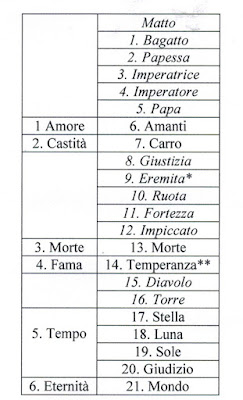
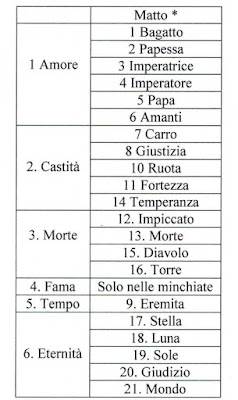
We can even change the story so that it is not Petrarch’s any longer, but a slight variation (putting Time earlier). It still just requires knowing the story that applies. Here is an example, using the same 16 cards as before but in the minchiate order (I owe this table to Franco, although not quite what I am doing with it; I hope you are noticing the overlap with the Naples group of 9). Here the idea of "groups of 4" still applies, using 4 four of the 6 Petrarchans to govern a group: Love, Chastity, Death, and Eternity.

We start out as the Empress or Emperor of our souls. We experience desire (Amor) in various ways and need the moral virtues of Temperance, Fortitude, and Justice, in order to steer the Chariot of our soul in relation to the ups and downs of Fortune. Growing Old, we know we will be defeated at least temporarily by Death. But what will defeat death is Faith, which gives us Hope that the goal that Prudence enables us to recognize will be attained with God’s charity, leading us to Glory when the Angel blows his trumpet.
This is a kind of simple catechism or “Hail Mary” rosary prayer to be learned in playing the game. It does not have to be taught; people can figure it out, or something like what I wrote, for themselves. Something of the sort is drummed into one's consciousness however the sequence is learned.The processions, with their religious emphasis, and other imagery around them, have made it easy.
The story I have imagined does not quite fit Petrarch’s order of triumphs. If we substitute the Star, Moon, and Sun for prudence and the three theological virtues the poem fits much better, in the way that John Shephard outlines in his table (see viewtopic.php?f=11&t=1120&start=40#p17956), with the Bagat, I think, more a tempter than a guide.
It is clear that actual processions did not give rise to the trumphal subjects of the tarot. Among processions, it is only the imaginary ones of Petrarch that can do so, at least for some of the subjects. Already believing this, I found myself becoming impatient with Pratesi. Why does he bother dredging up all these non-starters, when the processions that are relevant are right there in the poem itself?
However in retrospect a a few points are in fact clearer. Only one of his examples actually relates to specific cards of the tarot. But two others also relate, in terms of getting people used to the tarot’s type of structure.
The example that suggests actual cards is of course the Florentne-run truimphal parade in Naples (p. 7 above), with its seven virtues, fortune, and Caesar. These do indeed suggest cards that were probably present in the Florentine tarot of that time. It is true that the seven virtues were a common group everywhere then. But coupling them with Caesar, a Roman term for the Emperor, and Fortune was not common at all. It would have been even rarer to see them together as “triumphal” subjects. We have 9 cards.
Regarding the structure, Franco has already analyzed the example of the 16 banners, in a 4x4 array (p. 20). That structure might explain how it was that Marziano came up with the idea for his game. It was then only a matter of coming up with 16 classical subjects that could be put in a similar 4x4 array. These could then serve both as additional cards in each of the four suits, higher than the Kings, and as a suit in itself. A familiarity with the 4x4 array of banners might well have led to the 4x4 array of cards.
Such familiarity would also facilitate Florentnes’ ability to understand and appreciate a game with such an array. Each group would have a leader, similar to the four quarters of Sainta Maria Novella, San Giovanni, Santa Croce, and Santo Spirito. Within each group there would be a stipulated hierarchy, and the groups would also be arranged hierarchically. This would be something readily understood. The only odd part is that Marziano’s groups do not succeed each other, but rather the 2nd members of the groups succeed the 1st members (see the table at the beginning of http://trionfi.com/olympic-gods). That would take some getting used to. But I doubt if Marziano’s game ever made it to Florence.
I have suggested that the CY was conceived on such a 4x4 principle. There is good evidence for that hypothesis, in that the 11 triumph cards came to the Beinecke actually assigned each to one of the four suits That is a type of assignment that has not existed in card games since at least 1450, with Marcello’s letter (I think it is safe to assume that Marziano’s game never caught on in Anjou), and the assignments do not resemble any tarot order. Below, the titles in capitals have the suit assignments given in the Beinecke (S=Swords, B=Batons, C=Cups, D=Coins). The ones in italics are my guesses. I do not know whether the order of the suits here was part of what was received by the Beinecke or not. I list them in the same order they do.
I have suggested a rationale for the assignments, the principle of each group (1-4, 5-8, 9-12, 13-16) being related to one of the four cardinal virtues. The hierarchy of the groups, I have speculated, was determined by something else, namely the order of the 6 Petrarchan triumphs that appear in them. Something like that order, in at least 5 of the 6 corresponding early cards, does show traces in the existing subjects and their order (time, if the man with the hourglass, would be out of place). And of relevance to the St. John’s Day Parade, the groups succeed each other as groups, not as individuals whose value is determined by their place in their group. This is something that can continue to be true, as the triumphs expand to 22.
Another thing the processions teach is how to recognize a story from the succession of events in it, and vice versa, how to remember the order of given events by knowing the story of which these events form a part. The order of the series of 22 floats can be remembered largely in terms of the order of the biblical story that they represent, a story everyone participating would have known. At the same time the procession teaches that not all the items in a triumphal series have to fit the story. Some of the 22 in the procession do not stand for biblical events. It begins (p. 14):
It is only with the third group that the story begins. The others were perhaps to let the crowd know that the parade was starting, like when a movie begins with a bunch of credits.First moves the Cross of Santa Maria del Fiore, with all its clergy children, and in behind their six singers.
Second, the Companies of Jacapo the shearer and Nofri the cobbler, with about thirty children dressed in white and angels.
Third, the Building of Saint Michael Angel, who was standing above God the Father in a cloud: and in the Piazza opposite to the Signoria, a depiction of the battle of the Angel was dones, when Lucifer with his accursed angels was kicked out of heaven.
In that sense any story provides the means for knowng the order of given events within it. It is not necessary that each overcome the one before it. But this story is called “triumphs”. What makes the story triumphal, if not triumphing over what came before? One answer might be: the nature of the subjects themselves: the virtues do not triumph over one another, but they are triumphal—over the vices. Likewise, it might be said that the Bible is the story of God’s triumphs, and that each of the carts in the parade just cited represents one of them. The tarot, too, can be seen as god’s triumphs.
But let us suppose that the tarot isn’t about God, but about the human soul in relation to God. In that way it would be like the images conjured up by Petrarch in his Triumphi. Again, it is groups of cards that triumph over other groups of cards, like the Petrarchan triumphs including the people associated with them. There is one card for the Petrarchan/Boccaccian triumph, and other cards in the group are like the people following the cart. This is a scenario that fits the sequence whether it is as few as 6 cards (the Petrarchan ones) or as many as 22. The Saint John’s Day procession accustoms people to that structure, no matter how many groups it has, whether 10 or 22, and how many people are in the various groups.
We can even change the story so that it is not Petrarch’s any longer, but a slight variation (putting Time earlier). It still just requires knowing the story that applies. Here is an example, using the same 16 cards as before but in the minchiate order (I owe this table to Franco, although not quite what I am doing with it; I hope you are noticing the overlap with the Naples group of 9). Here the idea of "groups of 4" still applies, using 4 four of the 6 Petrarchans to govern a group: Love, Chastity, Death, and Eternity.
We start out as the Empress or Emperor of our souls. We experience desire (Amor) in various ways and need the moral virtues of Temperance, Fortitude, and Justice, in order to steer the Chariot of our soul in relation to the ups and downs of Fortune. Growing Old, we know we will be defeated at least temporarily by Death. But what will defeat death is Faith, which gives us Hope that the goal that Prudence enables us to recognize will be attained with God’s charity, leading us to Glory when the Angel blows his trumpet.
This is a kind of simple catechism or “Hail Mary” rosary prayer to be learned in playing the game. It does not have to be taught; people can figure it out, or something like what I wrote, for themselves. Something of the sort is drummed into one's consciousness however the sequence is learned.The processions, with their religious emphasis, and other imagery around them, have made it easy.
The story I have imagined does not quite fit Petrarch’s order of triumphs. If we substitute the Star, Moon, and Sun for prudence and the three theological virtues the poem fits much better, in the way that John Shephard outlines in his table (see viewtopic.php?f=11&t=1120&start=40#p17956), with the Bagat, I think, more a tempter than a guide.