With this note and another note to follow, we
move to the Kingdom of Sardinia in the early years of the 19th century.
The original title is "Carte e tarocchi a Sassari all’inizio
dell’Ottocento," posted at https://www.naibi.net/A/TASASSA.pdf
on Aug. 2, 2023 - so I am going back and picking up notes of Franco's
skipped earlier. Again, the numbers by themselves in the left margin are
the page numbers of Franco's pdf. The illustration is an addition for
THF, following the dictum that a picture is worth many words. I have
also taken the liberty of putting Fanco's itemization of his
descriptions of the cards in bulleted list format, for easier reference.
The text itself follows Franco's.
Cards and tarot cards in Sassari at the beginning of the nineteenth century
Franco Pratesi
1. Discovery and investigation of the cards
During a search on the Manus Online catalog dedicated to Italian manuscripts, I identified an unusual set of playing cards preserved in Sassari. In the history of ancient playing cards, some are quite often encountered that were used to strengthen the bindings of old books; in this case, the number of cards is higher than average. A particular interest is represented by the presence of tarot cards, also because we know very little about their diffusion in Sardinia. I then asked the University Library of Sassari for information. After a few exchanges of e-mails it turned out that the manuscripts and cards searched for were not kept in the Library of the University of Sassari but in the University Library of Sassari, with a different administration than the previous one; so, after a couple of confusing requests, I was kindly directed by the librarian of the first to Dr. Deiana, librarian of the second.
At this point, I was only looking for a manuscript with associated playing cards, ms. 72/II. Once in contact with the right person, I checked again and found, again with Manus Online, the five cases indicated below. Dr. Deiana thus had to engage in an unusual search, finding three of the five envelopes or boxes with playing cards attached to the manuscripts; he then sent me the three relevant scans, with an undertaking on my part not to publish or distribute them.
If I were an expert on the subject, it wouldn't be a big deal because I could describe every detail useful even without presenting images. But knowing my limitations I believe that the best solution, and perhaps the only one will be to contact Doctor Deiana directly to complete the following summary description. For my part, I asked that they at least make the scans available to scholars on the Library's web pages. This study may be the first of two, with the second accompanied by figures and further information (hopefully including other playing cards), or there will remain half a study to be completed by whoever will take care of it.
2. Cards of manuscript 72/I
I begin the description, and I will also do so in subsequent cases, by reporting what is found in this regard in the Library catalog.
2
3. Cards of manuscript 72/II
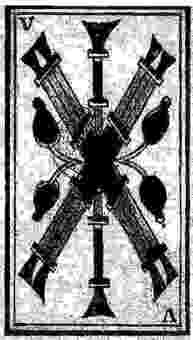 FIVE OF BATONS.jpg
Viewed 48 times 4.67 KiB
From G. Berti, M. Chiesa, Th. Depaulis, Antichi Tarocchi liguri-piemontesi., p. 88.
4. Cards of manuscript 75/III
During the phases of restoration, 16 printed cards and 31 hand-painted woodcut playing cards were recovered inside the cover, now restored and preserved in the folder with location ms. 75/III, prog. 10, shelf 6, Manuscripts and Rare [Books] Room of the University Library of Sassari.
There are 32 cards collected in four rows of eight; I will indicate them from top to bottom and from left to right.
The number cards [in the French suits] are usually of very low quality, so much so that they almost look like elementary school exercises; this may be partly due to wear, but there is no glimpse, even originally, of a good level of craftsmanship with the correct use of the typical stencils. Something like this would have been more normal for ordinary cards from a century or two earlier. The same coloring process, however, is of at least sufficient quality in the case of the court figures, with correct coverage of the pre-established areas; however, even in the court cards the suit-signs are painted freehand. Beyond the typical characteristics of these decks and the particular workshop from which they come, the general type is what is internationally called the Dauphiné/Piedmont pattern, most widespread in the eighteenth century in Piedmont, regardless of whether the origin was from the card makers of Grenoble, Lyon, or Turin.
_____________
1. G. Berti, M. Chiesa, Th. Depaulis, Antichi Tarocchi liguri-piemontesi. Turin 1995 on p. 88.
3
5. Cards not found
According to the catalog, in addition to the playing cards found and briefly described above, there should be others.
6. Comparison with the Recchi tarocchi of Oneglia
In the tarot literature, there is only one potentially similar precedent. This time the Tarot History Forum was useful to me [note 2]. Searching for information on Sardinia, various entries appear, and in particular a discussion based on a short passage from the highest authority on the subject. Given the importance of both the author and the Liguria-Sardinia relationship, I copy it below.
We cannot expect a big difference between Oneglia and Finale. Both cities produced far more playing cards than would be required by the city's market. Most of the production was directed towards nearby and even distant countries, even as far as the Americas in some cases. In particular, they often served as contraband goods to avoid paying the stamp
_____________________
2. viewtopic.php?f=11&t=1212&p=19699&hilit=Sardinia#p19699
3. M. Dummett, Il Mondo e l’Angelo. Naples 1993, pp. 406-407.
4. S. R. Kaplan, The Encyclopedia of Tarot Vol. II, New York 1986, on p. 358.
5. Historic Cards and Games. New York 2006, on p. 37.
4
tax that almost all states had imposed on playing cards. (Decks also arrived in Florence, as I encountered in the archive documents.)[note 6]
The peculiarity of the Ligurian tarot deck produced for Sardinia is a modification of the standard cards to bring them closer to Spanish use, as has been reported for other regions of southern Italy and the islands. From the few tarot cards present in Sassari it is not easy to arrive at detailed and precise conclusions, but one can already point out a fixed point: these tarot cards have little or nothing in common with the Recchi di Oneglia ones; moreover, no Spanish modification is observed here.
7. Information on other tarot cards from Giacomo Drago's factory in Finale Ligure
Thierry Depaulis has conducted basic studies on playing cards and card makers in Piedmont and Liguria.[note 7] Of particular interest in defining the provenance of the Sassari cards is a piece of information which in another of his writings we find on the card maker involved.
In conclusion, the comparison with the Draghi-Kaplan deck, unlike that with the Recchi deck, confirms for the Sassari cards not only the place of production, which was indicated, but also the date, with an uncertainty of just a few years.
8. Discussion, hypotheses and conclusions
To explain the situation that led to the discovery of these playing cards in Sassari, several hypotheses can be put forward. However, the production date of these cards already allows us to exclude many possibilities; meanwhile, the date of 1986, in which they were accidentally discovered during restorations, is obviously of no importance, being a couple of centuries later. Furthermore, at the other end of the times connected to the manuscripts, we can exclude a direct involvement of their compiler.
Although not involved with playing cards, the Friar-Minor [Franciscan] Antonio Sisco, author of these manuscripts, deserves some attention. He was certainly an important figure: born in Sassari in 1716 into a wealthy family, he studied in Assisi and Turin, where he graduated before returning to Sassari in the Convent of the Minors of Santa Maria di Betlem where he stayed until his death; he had been promoted to provincial and then general commissioner of the order, qualifier of the holy office and examiner of the diocese of Porto Torres. His activity as a writer was extraordinary, both as a copyist of works by other authors and as an author of his own works.
If we search for his name among the manuscripts of Sassari, Manus Online presents us with 120. In this incredible number of manuscripts compiled by him there are several of our interest because there
______________
6. F. Pratesi, The Playing-Card, 21 No. 4 (1993) 126-135.
7. Th. Depaulis, Cartes et cartiers dans les anciens états de Savoie (1400-1860). IPCS Papers No.4 2005.
8. G. Berti, M. Chiesa, Th. Depaulis, Antichi Tarocchi liguri-piemontesi. Turin 1995 on p. 22.
9. viewtopic.php?f=11&t=754&p=10768&hilit=Draghi#p10768
10 S. R. Kaplan, The Encyclopedia of Tarot Vol. II, New York 1986, on p. 350.
5
playing cards (from a later period) were found inserted as reinforcement of the cover. Finds of this kind are known from various times and locations, even preceding a couple of centuries. In short, the use of playing cards to reinforce bindings is not a strange thing. The unusual thing is that everything comes from a convent of Friars-Minor.
In those years, Sassari was emerging from a very turbulent period in which repeated episodes of civil war between Sassari and Cagliari had been added to the consequences of the battles between the Piedmontese and the French. After the most eventful years, the newfound peace did not coincide with a flat return to the old days and the winds of renewal continued to blow. On the specific situation in the convent of the Friars-Minor of Santa Maria di Betlem in Sassari, without studying it further, I can now only imagine something plausible.
The overcoming of the revolutionary ideas coming from France must have felt like a relief. It was possible to return with conviction to traditional teachings, and in this field the numerous manuscripts left by the general commissioner Antonio Sisco could be useful and deserve a partial restoration. Many had been written specifically with a view to teaching, and the author's fame must have still been alive. In particular, it still appears necessary to assume that, decades after the author’s death, the Friars Minor of Santa Maria di Betlem decided to have his manuscripts bound, which then remained at the disposal of the same convent until the suppression of the order in 1855.
A further hypothesis, which seems reasonable to me, is that the Friars Minor asked for the restoration from a local craftsman, who could conveniently dispose of old playing cards that had nothing to do with the convent. (If the friars had done the work themselves it would not change the substance, except that some other hypothesis would have to be formulated on the use and local origin of the playing cards.) This obviously could not have happened in any case before the years around 1805, when the cards were produced, but also not many years later, considering the short lifespan of these objects in common use.
Of course, the historical importance of the playing cards found appears infinitesimal in the context of municipal events, but for the history of games it retains some importance, if only as a further rare testimony to the use of tarot cards in Sardinia. In conclusion, the cards examined were certainly produced in Finale Ligure at the beginning of the nineteenth century but were used in Sardinia - which does not mean produced for Sardinia. The 3 of batons tarot card is enough to indicate that something similar is found in various types of Ligurian and Piedmontese tarots of the time, but not in other areas where knotty sticks had long established themselves.
Cards and tarot cards in Sassari at the beginning of the nineteenth century
Franco Pratesi
1. Discovery and investigation of the cards
During a search on the Manus Online catalog dedicated to Italian manuscripts, I identified an unusual set of playing cards preserved in Sassari. In the history of ancient playing cards, some are quite often encountered that were used to strengthen the bindings of old books; in this case, the number of cards is higher than average. A particular interest is represented by the presence of tarot cards, also because we know very little about their diffusion in Sardinia. I then asked the University Library of Sassari for information. After a few exchanges of e-mails it turned out that the manuscripts and cards searched for were not kept in the Library of the University of Sassari but in the University Library of Sassari, with a different administration than the previous one; so, after a couple of confusing requests, I was kindly directed by the librarian of the first to Dr. Deiana, librarian of the second.
At this point, I was only looking for a manuscript with associated playing cards, ms. 72/II. Once in contact with the right person, I checked again and found, again with Manus Online, the five cases indicated below. Dr. Deiana thus had to engage in an unusual search, finding three of the five envelopes or boxes with playing cards attached to the manuscripts; he then sent me the three relevant scans, with an undertaking on my part not to publish or distribute them.
If I were an expert on the subject, it wouldn't be a big deal because I could describe every detail useful even without presenting images. But knowing my limitations I believe that the best solution, and perhaps the only one will be to contact Doctor Deiana directly to complete the following summary description. For my part, I asked that they at least make the scans available to scholars on the Library's web pages. This study may be the first of two, with the second accompanied by figures and further information (hopefully including other playing cards), or there will remain half a study to be completed by whoever will take care of it.
2. Cards of manuscript 72/I
I begin the description, and I will also do so in subsequent cases, by reporting what is found in this regard in the Library catalog.
They are five cards more or less widely cut out at the margins.During the phases of restoration, 9 printed cards, 4 printed fragments and 5 woodcut playing cards were recovered inside the cover, one of which bears the writing “Fabbrica di Giacomo Drago” now preserved in the folder with location ms. 72/I, prog. 21/I, shelf 6, Manuscripts and Rare [Books] Room of the University Library of Sassari.
- The top three are a 7 of diamonds, an Ace of clubs, and an 8 of cups from a tarocchi deck.
- The bottom two are a Jack of Spades and a Queen of clubs [in what are called “French suits” – the usual ones in 52-card decks today].
2
3. Cards of manuscript 72/II
They are six cards, three upper, three lower. From left to right:During the phases of restoration, 14 parts of a printed antiphonary, 9 manuscript fragments, 5 woodcut playing cards from the "Fabbrica di Giacomo Drago" and one tarocco were recovered inside the cover and are now preserved in the folder with location ms. 72/II, prog. 21/II, shelf 6, Manuscripts and Rare [Books] Room of the University Library of Sassari.
- above: Queen of Hearts, Queen [actually King of hearts, Franco says in the sequel essay] (the suit cannot be seen because from the middle of the face upwards the figure is as if erased, becoming completely white, but without a clear margin between the two areas), King of Clubs.
- below: VIII Justice and III of batons from a tarocchi deck; King of hearts.
4. Cards of manuscript 75/III
During the phases of restoration, 16 printed cards and 31 hand-painted woodcut playing cards were recovered inside the cover, now restored and preserved in the folder with location ms. 75/III, prog. 10, shelf 6, Manuscripts and Rare [Books] Room of the University Library of Sassari.
There are 32 cards collected in four rows of eight; I will indicate them from top to bottom and from left to right.
- First row: 6 of spades, 2 of spades (fragment of width reduced to half with cuts from the two edges), 7 of hearts, 2 of hearts (deleted at the bottom, less probably a 3), 2 of clubs, 4 of Clubs, 7 of Clubs, Ace of Hearts.
- Second row: 7 of spades, 3 of diamonds, 5 of spades, Ace of clubs, 2 of diamonds, Ace of spades, Ace of spades, Ace of diamonds, 4 of hearts.
- Third row: 4 of spades, 7 of hearts, 3 of clubs, 3 of diamonds, 2 of spades, 7 of hearts, Jack of hearts, King of clubs.
- Fourth row: Jack of diamonds, Queen of hearts, King of diamonds (white card above shoulder height of the face, suit not visible), Queen of diamonds, Queen of diamonds, King of hearts, King of spades, King of clubs.
The number cards [in the French suits] are usually of very low quality, so much so that they almost look like elementary school exercises; this may be partly due to wear, but there is no glimpse, even originally, of a good level of craftsmanship with the correct use of the typical stencils. Something like this would have been more normal for ordinary cards from a century or two earlier. The same coloring process, however, is of at least sufficient quality in the case of the court figures, with correct coverage of the pre-established areas; however, even in the court cards the suit-signs are painted freehand. Beyond the typical characteristics of these decks and the particular workshop from which they come, the general type is what is internationally called the Dauphiné/Piedmont pattern, most widespread in the eighteenth century in Piedmont, regardless of whether the origin was from the card makers of Grenoble, Lyon, or Turin.
_____________
1. G. Berti, M. Chiesa, Th. Depaulis, Antichi Tarocchi liguri-piemontesi. Turin 1995 on p. 88.
3
5. Cards not found
According to the catalog, in addition to the playing cards found and briefly described above, there should be others.
There are also at least four other manuscripts with the same characteristics of having associated folders with fragments of cards found in the covers at the time of the restoration. These are the following: ms. 34+35, ms. 48, ms. 81/1-2 and ms. 167n; In these cases, however, the catalog only indicates "cards" [carte, also meaning “pieces of paper” or other types of cards] without the specification "playing." I asked the librarian to do a check and the search has so far turned up no information on any playing cards.Ms. 56-a-bis - Ms. 56 is a miscellany collected by p. [padre?] Antonio Sisco; the parts each have their own signature with a letter subordinate to the number, from A to N. The manuscript 56-a-bis is preserved in the same box; it is a folder with the parts of the cover of the manuscript inside. 56/a: five fragmentary folios handwritten by Sisco; a “4 of Coins” playing card handwritten on the back; two marbled cards; fourteen printed music sheets. All the cards have been restored and show a pencil numbering given by the restorer; total 22 cards.
Ms. 68 – During the restoration phases, a small stack of 8 printed cards and 22 hand-painted woodcut playing cards was recovered from inside the deck, now restored and preserved in the folder with location ms. 68, shelf 6, Manuscripts and Rare [Books] Room of the University Library of Sassari.
6. Comparison with the Recchi tarocchi of Oneglia
In the tarot literature, there is only one potentially similar precedent. This time the Tarot History Forum was useful to me [note 2]. Searching for information on Sardinia, various entries appear, and in particular a discussion based on a short passage from the highest authority on the subject. Given the importance of both the author and the Liguria-Sardinia relationship, I copy it below.
This tarot deck was auctioned with the part of the Kaplan collection to which it belonged and a black and white reproduction of 20 cards can be found in his Encyclopedia [note 4] and, in color, of 13 cards and a back in the auction catalog. [note 5] This allows for a fairly safe comparison.Finally, from Oneglia in Liguria comes the only example known to me of a tarot deck with Spanish suits. It is the work of Giacomo Recchi, whose name and city appear on a panel of the Ace of Coins; one example is in the collection of Stuart Kaplan, who dates it to around 1820 due to the tax stamp of the kingdom of Sardinia, used from 1815. The deck, engraved on copper, is made up of seventy-eight single-headed cards. The trumps were adapted from the first version of the Piedmontese Tarot; their inscriptions, like those of the suit figures, are in French. There are Roman numerals in a panel on top of the triumphs and on the sides of the numeral cards. Death (XIII) is unwritten; the Devil (XV) has a face on his stomach and is not wearing a hat. The suit cards are adapted from the designs of the famous 1810 deck, also engraved on copper, by Clemente Roxas of Madrid. Since that deck is the prototype of the current standard model of the normal deck in Sardinia, it is almost certain that Recchi's deck was intended for that island, where Tarocchi is still played today. [note 3]
We cannot expect a big difference between Oneglia and Finale. Both cities produced far more playing cards than would be required by the city's market. Most of the production was directed towards nearby and even distant countries, even as far as the Americas in some cases. In particular, they often served as contraband goods to avoid paying the stamp
_____________________
2. viewtopic.php?f=11&t=1212&p=19699&hilit=Sardinia#p19699
3. M. Dummett, Il Mondo e l’Angelo. Naples 1993, pp. 406-407.
4. S. R. Kaplan, The Encyclopedia of Tarot Vol. II, New York 1986, on p. 358.
5. Historic Cards and Games. New York 2006, on p. 37.
4
tax that almost all states had imposed on playing cards. (Decks also arrived in Florence, as I encountered in the archive documents.)[note 6]
The peculiarity of the Ligurian tarot deck produced for Sardinia is a modification of the standard cards to bring them closer to Spanish use, as has been reported for other regions of southern Italy and the islands. From the few tarot cards present in Sassari it is not easy to arrive at detailed and precise conclusions, but one can already point out a fixed point: these tarot cards have little or nothing in common with the Recchi di Oneglia ones; moreover, no Spanish modification is observed here.
7. Information on other tarot cards from Giacomo Drago's factory in Finale Ligure
Thierry Depaulis has conducted basic studies on playing cards and card makers in Piedmont and Liguria.[note 7] Of particular interest in defining the provenance of the Sassari cards is a piece of information which in another of his writings we find on the card maker involved.
Thanks again to Tarot History, [note 9] I was able to follow the traces of a tarot deck "Per Giacomo Draghi": this too belonged to the Kaplan Collection and is described in his Encyclopedia, including a full-page illustration with the black and white reproduction of 20 cards.[note 10] Between these and the Sassari cards there is only Justice in common. The two Justice cards are clearly very similar, although stating that they are from the same woodblock is not entirely certain for me (for example, the facial features may appear slightly sharper in the Kaplan card, but the comparison presents itself as a puzzle game of difficult solution). [Franco says that the part of the card with the title is cut off, so it is unclear whether the language was Italian or French.]Also in the Finale area we find manufacturers whose production we know: Giacomo Draghi – who signs a deck of tarot cards around 1805, when Liguria was French, “Jacques Dragau” – and his successor Paolo Drago (around 1830) . . . [note 8]
In conclusion, the comparison with the Draghi-Kaplan deck, unlike that with the Recchi deck, confirms for the Sassari cards not only the place of production, which was indicated, but also the date, with an uncertainty of just a few years.
8. Discussion, hypotheses and conclusions
To explain the situation that led to the discovery of these playing cards in Sassari, several hypotheses can be put forward. However, the production date of these cards already allows us to exclude many possibilities; meanwhile, the date of 1986, in which they were accidentally discovered during restorations, is obviously of no importance, being a couple of centuries later. Furthermore, at the other end of the times connected to the manuscripts, we can exclude a direct involvement of their compiler.
Although not involved with playing cards, the Friar-Minor [Franciscan] Antonio Sisco, author of these manuscripts, deserves some attention. He was certainly an important figure: born in Sassari in 1716 into a wealthy family, he studied in Assisi and Turin, where he graduated before returning to Sassari in the Convent of the Minors of Santa Maria di Betlem where he stayed until his death; he had been promoted to provincial and then general commissioner of the order, qualifier of the holy office and examiner of the diocese of Porto Torres. His activity as a writer was extraordinary, both as a copyist of works by other authors and as an author of his own works.
If we search for his name among the manuscripts of Sassari, Manus Online presents us with 120. In this incredible number of manuscripts compiled by him there are several of our interest because there
______________
6. F. Pratesi, The Playing-Card, 21 No. 4 (1993) 126-135.
7. Th. Depaulis, Cartes et cartiers dans les anciens états de Savoie (1400-1860). IPCS Papers No.4 2005.
8. G. Berti, M. Chiesa, Th. Depaulis, Antichi Tarocchi liguri-piemontesi. Turin 1995 on p. 22.
9. viewtopic.php?f=11&t=754&p=10768&hilit=Draghi#p10768
10 S. R. Kaplan, The Encyclopedia of Tarot Vol. II, New York 1986, on p. 350.
5
playing cards (from a later period) were found inserted as reinforcement of the cover. Finds of this kind are known from various times and locations, even preceding a couple of centuries. In short, the use of playing cards to reinforce bindings is not a strange thing. The unusual thing is that everything comes from a convent of Friars-Minor.
In those years, Sassari was emerging from a very turbulent period in which repeated episodes of civil war between Sassari and Cagliari had been added to the consequences of the battles between the Piedmontese and the French. After the most eventful years, the newfound peace did not coincide with a flat return to the old days and the winds of renewal continued to blow. On the specific situation in the convent of the Friars-Minor of Santa Maria di Betlem in Sassari, without studying it further, I can now only imagine something plausible.
The overcoming of the revolutionary ideas coming from France must have felt like a relief. It was possible to return with conviction to traditional teachings, and in this field the numerous manuscripts left by the general commissioner Antonio Sisco could be useful and deserve a partial restoration. Many had been written specifically with a view to teaching, and the author's fame must have still been alive. In particular, it still appears necessary to assume that, decades after the author’s death, the Friars Minor of Santa Maria di Betlem decided to have his manuscripts bound, which then remained at the disposal of the same convent until the suppression of the order in 1855.
A further hypothesis, which seems reasonable to me, is that the Friars Minor asked for the restoration from a local craftsman, who could conveniently dispose of old playing cards that had nothing to do with the convent. (If the friars had done the work themselves it would not change the substance, except that some other hypothesis would have to be formulated on the use and local origin of the playing cards.) This obviously could not have happened in any case before the years around 1805, when the cards were produced, but also not many years later, considering the short lifespan of these objects in common use.
Of course, the historical importance of the playing cards found appears infinitesimal in the context of municipal events, but for the history of games it retains some importance, if only as a further rare testimony to the use of tarot cards in Sardinia. In conclusion, the cards examined were certainly produced in Finale Ligure at the beginning of the nineteenth century but were used in Sardinia - which does not mean produced for Sardinia. The 3 of batons tarot card is enough to indicate that something similar is found in various types of Ligurian and Piedmontese tarots of the time, but not in other areas where knotty sticks had long established themselves.
Florence, Aug. 2, 2023
Translator's note: A translation of the sequel to this note may be found at https://pratesitranslations.blogspot.com/2023/12/october-16-2023-cards-and-tarocchi-at.html

