Sunday, September 17, 2023

Aug. 20, 2023: Brescia 1786 - almanac on the tarot

Translator's introduction: This is a translation of Franco's "Brescia 1786 - almanacco sul tarocco," at https://naibi.net/A/TABS86.pdf, which he posted on August 20, 2023. Comments in backets are mine, after consultation with Franco, who has also made numerous suggestions for the translation itself. A few comments of my own follow the translation. 

Brescia 1786: almanac on the tarot


Franco Pratesi                 

1. Information and research
    In recent months I have been researching the first editions published in Milan at the end of the eighteenth century on the game of tarocchi. Thierry Depaulis[1] had reported them as still remaining to be studied despite the fact that Dummett and McLeod[2] had used many subsequent reprints of them in their fundamental treatise on tarot games. The results of my studies have been included on a website and among these I would like to indicate  two [3], because they have brought to light a series of three editions of an unknown manual which, unlike the others, taught precisely the most appropriate ways of playing.
 
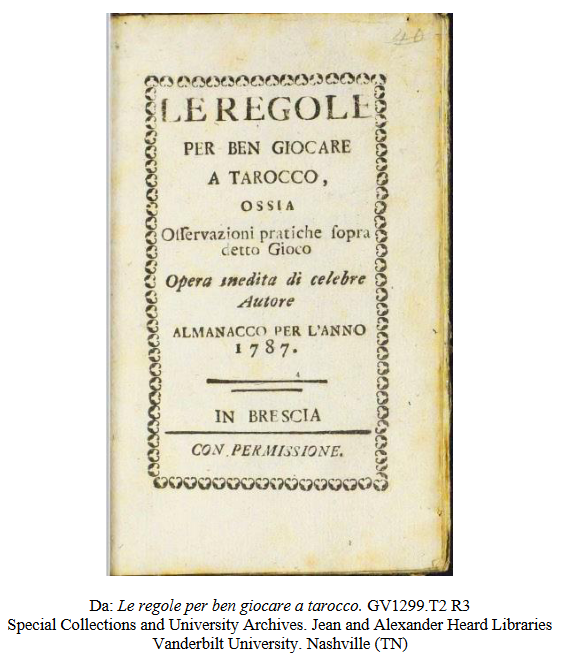
   Here, however, I am studying for the first time a seemingly similar almanac, which we will see has practically only the title similar: The rules for playing tarot well, or Practical observations on the said Game. Unpublished work by a famous author. Almanac for the year 1787 [Le regole per ben giocare a tarocco, ossia Osservazioni pratiche sopra detto Gioco. Opera inedita di celebre Autore. Almanacco per l’anno 1787], Brescia (1786). Of particular interest is the date, an almanac for 1787, and therefore almost certainly already printed in 1786, in any case before the Milanese editions studied. This isn't even a Milanese edition, but a Brescian one, truly unusual.
 
2
    This rare example was reported to me privately by Thierry Depaulis, who had found the title in the bibliography of a well-known book on the history of playing cards.[4] Naturally, I immediately started the research by checking the main digitalized catalogs available online; this research ended with the result that only one copy of this almanac was preserved throughout the world, in the collection of the US Playing Card Society. I don't know if that entire collection, or just a part, was then transferred to the Vanderbilt University library; certainly, the work to be studied is found there today.
 
    I had had the opportunity to contact libraries in the USA several times and I had never encountered any difficulties; indeed, in some cases they seemed "closer" to me than some of the European and even Italian ones. I therefore confidently wrote to the library asking for information: in particular, I needed the scans, but only of the part on tarocchi, and I didn't know how many and what the relevant pages were, before the calendar and any other miscellaneous information typically present in that type of almanacs. I was then waiting for the response to order the exact number of scans. The answer didn't reach me. Fortunately, on the library's web page there are the addresses of the librarians with their portraits, roles, and specializations, in an incredibly large number; almost all of them appear smiling and suggest kindness and helpfulness. I chose a lady who specialized in Italian books, but she didn't answer me; I tried to contact a lady curator of the section involved, with the same result; in the end I didn't get any response, even from the director of the entire section himself.
    To understand and seek help, I tracked down the address of the librarian who had been in charge of the USPCS collection before it moved to Vanderbilt; he replied that he also understood that those librarians were not very helpful to scholars who asked for personal assistance, and he couldn't help me; he suggested a possible intermediation to gain access, which however didn't work.
    I had recently had very useful assistance from Francesco Cignoni of the State Library of Cremona, a library that has some form of association with that of Brescia, and so I asked him if those two libraries could find a suitable opportunity to request the scans. So Marina Gentilini, from the interlibrary loan service in Cremona, made a standard request and incredibly quickly received a free scan of the entire almanac, including the covers, in a short time. All's well that ends well.

2. Summary of the text

   In general, we learn that a certain Abbot Cantelli was interested in the developments of science and sought useful applications for the people; in the environment, there were those who did not follow him, but there were also scholars who continued his research after his premature death. He had left various writings, including one dedicated to the game of tarocchi, from which some suggestions are taken here, with also references to other cases that make us understand the versatility of that "scientific" method.
   After the Preface, we get to the heart of the "instructions." The 6 of Coins is “the unhappiest card”; if it turns up, you must discard it as soon as possible, preferably on the opponents' tricks to reduce the loss. The Page [Jack] of Cups was considered this way in the century past, but Cantelli's research has shown that it is a card like any other. The Ace of Batons, considered an "omen of misfortune" for fifteen years, has been confirmed as an unfortunate card equal to or worse than the 6 of Coins. The widely followed habit of systematically discarding Swords is not recognized as valid. The right to cut before the distribution must not be waived.
   By winning 13 points in the first hand, if in the second you lose even one, you lose the game; however, if instead you win a few more points it becomes double. Reaching 31 in three hands, the game will be won easily, and between four experts, the fourth hand is not even played. However, if the points are less than 30, a favorable contract can be made to achieve a simple and not double loss. There follows an

3
example of a change from 28 to 35 points with the hope of winning triple and then an error in the fourth hand and a simple loss; then another with a similar outcome.  
   On the first card played in a suit "mostly the player has either only one, or many of that suit, which he plays" [per lo più il giocatore ne ha o una sola, o molte di quel palo, che gioca], and therefore the King must be played immediately. On the partner's King, the Queen must be given without hesitation.
   Example of the jurist: playing with someone who knew the rules, he sees that everything that was predicted occurs and asks for explanations. The answer is that experience teaches us, as in the case of cats who, if born in March, are better at catching mice; black hens are better than white ones for headaches, dark-haired cows give more milk than light-colored ones. Dr. Balbi of Bologna was unable to cure a tertian patient but when asked how much he had to suffer, he replied that he would be cured on the solstice, as he was. The explanation? The doctor's response was that he attributed no merit to himself for the treatment because it was simply experience that taught him that those fevers pass on their own with the seasons. It is surprising that jurists, like the ecclesiastics introduced shortly after, do not engage enough in the game of tarot.  
   On the playing of the Lottery [Lotto], observations have shown that dreams are deceptive, while it may be that a low moon corresponds to low numbers and vice versa for high ones. On the game of Pharaoh, studies are still underway, but there is the risk that when scholars find a valid system they will not be able to apply it. 
   The rules are useless "when you operate differently," as happens with the "witty little Ladies" who talk about other things while playing and lose a lot of money. The abbot's last observation concerns the study of "knowing how to cut [levare, literally "raise," in this case separating it into two parts] well," which remained unfinished due to his premature death; there is only the criticism of young people who make them divide [cutting in more than one place].

3. Comments and conclusion  

The first comment that immediately comes to mind is that this text is different from all the others of the genre and that it can also be considered an exception as a way of "teaching" the rules of tarocchi. Other booklets of this kind could also be criticized, as they typically limited themselves to teaching only the penalties incurred by players who made mistakes, but in this case nothing, or almost nothing, is learned from reading the text.
   The text is very incorrect and even ungrammatical, for several reasons. The first is the use of antiquated terms, the second is spelling with errors repeated partly in a coherent manner, partly intermittently - and in this regard, the lack of experience and attention of those who composed these pages for the press is also evident. This contributes, but is not the primary reason, because of the rambling character of the whole text. The presence of some Latin phrases, which in effect simply translate what has already been written in Italian, is not enough to raise the level.
   Once the reading difficulties have been overcome, there remain some difficulties in understanding the environment, which were probably not felt by the readers of the time, starting with the "Cantellian theories" themselves and their respective followers. The main question is how seriously the thing was to be taken. Possibly everything lent itself to a double reading: those who were seriously trying to learn something here, [and] those who laughed about it - read today, naturally only the second remains.
   In the Preface, we begin with the protagonist of the whole discussion, Abbot Cantelli, the presumed author of a work on tarocchi that the publisher uses for publication. I haven't found any traces of him in the encyclopedias, and therefore he could be a completely invented character. I think rather of a “natural philosopher” known in the environment. Given how he is quoted, and how his followers are presented, one could also think of a derision of scholars who spend their time making calculations on astrological observations in order to derive useful information for the most diverse practical cases. In contrast to such a hypothesis is the news of the premature death of the protagonist: no one insists on making fun of a personage who recently died young.
   Leaving aside the protagonist, the abbot author behind the suggestions, let us examine the suggestions themselves and, above all, the environment that is shown to us. In the background are the scholars


4
of astronomy, or rather astrology, but their presence serves to give strength to the suggestions and  to enhance the progress of knowledge in the scientific field. In the foreground is the population of players, first of all the tarocchi players, but then also of other games including the lottery, with their long-standing habits and their credulity. Typical in this regard is the habit of playing lottery numbers based on dreams, a custom that lasted (and lasts!) for a long time; in this context, confidence in the position of the moon no longer appears scientific to us.
   A recurring aspect is the need to come to the table to play tarocchi with a good knowledge of the "scientific" rules. The jurists on the one hand and the ecclesiastics on the other would seem to be the best predisposed to take the game seriously, also due to the commitment necessary to reach their professions, but those among them who prove themselves to be good tarocchi players are an exception and not the rule; they are therefore invited, as a category, to dedicate themselves to learning and practice. But the greatest attention goes to another category, that of women: they are described as distracted and incompetent players, so much so that they systematically lose a lot of money; hence the recommendation to women to study and not show up at the gaming table to make the usual "sad appearance."
   Perhaps the most important information for the history of the game is that in Brescia it is known that "The game of Tarocchi has now come into fashion not only in the conversations in Italy, but also in different parts of Europe." The game of Tarocchi is seen as a fashionable game in gaming halls. It happened with the game of hombre, it will happen with whist – long-lasting and European-wide fashions. Evidently in these "conversations" one did not play with small change. As a rule, these were the cream of the cream of society, people who could lose a lot of money before they were completely ruined; passing players who came from nearby locations - such as the Milanese patrician and the Como knight -  were evidently also part of the highest social class.
   We learn little about the actual game of tarocchi and nothing that we didn't know from other sources. Some habits of players are criticized, such as that of systematically choosing the cards of the suit of spades for discarding, or that of giving up cutting the deck before the distribution. The various levels of losses and the attention necessary to avoid increasing the liabilities are encountered.

   We are struck, and this is new, by the fact that there were cards considered harmful. This about the tarocchi still has nothing to do with the Egyptian ideas of Court de Gébelin; here they are long-standing local traditions: in one case we are talking about fifteen years, but in another we are  talking about even a century. It seems indicative to me that these "special" cards are not found among the tarocchi, but among the cards of the common deck, which suggests that the same cards also had that reputation in other games. We aren’t talking about cartomancy, but if some cards have an ominous meaning it is possible that there are others with an auspicious meaning and, above all, one can imagine that they retained that meaning also outside the game, for example by randomly extracting them from the deck for seeing what card was shown. This path is imaginary, but from here the journey towards - if not from - divination is still very short.

4. Full copy of the text

   /p.3/ PREFACE. The tireless effort, even too much [pur = pure + troppo, but also suggesting purtroppo, unfortunately], practiced by the famous Abbate Cantelli on various subjects and objects aimed at enlightening, with patriotic zeal, people eager to learn the sciences that were previously recondite, is well known to the public.
   Among his other laborious experiments, which could be gleaned from his writings and Cantellian followers, said author set to work making all the most minute astronomical observations on the game of Tarocchi. /p. 4/ Perhaps such effort practiced by the immemorable [immemorabile, the author deliberately choosing a word meaning "quickly forgotten" but close to immemore, meaning, "remembered even when the author's name is forgotten"] Cantelli will seem popular and ridiculous; but if men of common sense penetrate to the core, they will know that the proposed system is more advantageous and profitable than anything else the designers of our times can invent.
   A comparison can be made on the basis of the present observations; and on the new systems, which are being spread by modern designers, and they will clearly know that becoming an expert in Tarocarian science is of no expense, where all the current experiments that are being invented by said Designers are almost always useless, and they make those who carry them out poor.

5
   The game of Tarocco has now come into fashion not only /p.5/ significantly in conversations in Italy, but also in various parts of Europe, and consequently it must push everyone to take possession of the rules, which cost so much sweat to the Author Cantelli.
   In fact, if the Noble Matrons who spend almost all day either in romantic entertainments or in embellishing themselves, now with paintings, and now with vague Garlands, want to consume some portion in the reading of this little Cantellian booklet, they will certainly not make that sad appearance in the evening at the game of Tarocco that they have already made before, with considerable disadvantage to their purse.
   The great Master therefore proposes this more than safe enthymeme in his new writings to those who want to attend /p.6/ the Tarocarian conversations. Either the player wants to put into practice what from long experience with astronomical reflections it has been possible to combine, and then it is certain that the player will make a good appearance, or he wants to neglect the knowledge that is even too much [pur = pure + troppo, but suggesting purtroppo, unfortunately] evident, and then abandons playing, because such a player will always be ridiculous.
   /p.7/ The Celebrated Cantelli says that in the game of Tarocco there is no card more unfortunate than the six of coins, therefore whoever, by bad luck, will have said card should be undeceived, that he will absolutely have to lose points in that hand also in the presence of excellent cards; He therefore proposes the remedy so that the loss can be less perceptible.
   Therefore, whoever has the six of coins should immediately try to play it, and make sure that it falls back into the hands of the adversary, finding no other remedy than to hand it over to the enemy party, because according to Astronomical observations, said card brings a pestilential influence, thus it will also be communicated to the adversary, and in this way the loss will be less perceptible.
   In the last /p.8/ century the Page [Jack] of Cups was considered by players as an unfortunate card, but as much as the Author Cantelli sweated over the speculation of said card, he found that it was prejudice that previously dominated, because it influences nothing.
   Therefore, the author says, players should not be saddened if they have the Jack of Cups, because it has no pestiferous influence, being a card equal to the others, which does not produce anything either malignant or propitious.
   The famous author left nothing relating to the Ace of Batons; Furthermore, it was about fifteen years ago that this card became known to players as a harbinger of misfortune and fatality. In fact, this card is on par with the six of coins, and brings, if not worse, at least equal influences to whoever holds it.
   This advantageous discovery is entirely due to the zeal and tireless study of those who in the most lunar hours, were able to fix its pestilence.
   The famous Author follows says openly, that whoever discards swords, discards on his partner! Who could ever sufficiently praise such a Hero, /p.9/ who was able to match with [coi] continuous Astronomical Calculations, the pestilential influence that leads those who obstinately want to discard swords. He says that he who wants to discard swords at his own discretion will probably find the King in the hands of his partner, and if it is not, the opponent will take it because that King, according to astronomical calculations, is exempt from any storm: He therefore urges all players to abandon such a discard and cling to another suit, and despite the fact that according to the laws of Tarocco it seemed disadvantageous, it will always turn out useful to Professor Canteliano.
   When things go well, don't do anything new, and whoever doesn't cut [azare] doesn't win, says the erudite Master. There are many who do not raise [azare; can also mean “lift up”] the cards, and allow the Adversary to deal them as they are. This is madness; while no matter how many mathematical and astronomical experiments the Author has carried out, he has always recognized as a loser one who embraces this practice of not cutting. In fact, there is a certain noble Matron, who remains with her hands on her apron, so as not to bother moving her hand to /p.10/ cut the cards, she lets the cards go as the discarder [dealer] likes, and thus remains mocked by the shrewd player.
   Always intent on new discoveries, the erudite Author was able to establish that whoever wins thirteen points in the first hand, if in the second hand he loses even just one point, the game is lost, there is no escape; but if in the second hand he still wins a few points, in that case it is certainly a double [di due, by two, twice the points of a single?]. This rule is very certain, and therefore Cantelli warns the players to keep an eye on this observation, and try as best they can to reach an agreement: such are the feelings of the Author Cantelli: Si autem una pars tresdecim puncta vicerit in prima manu, punctum aliquod vicerit etiam in secunda, tunc alia pars ludens illico, & immediatè transactionem facere curet; aliter parcella absolute erit de duobus. [But if one party has won thirteen points in the first hand, and has won some point also in the second, then the other party, playing on the spot, shall take care to make an agreement immediately; otherwise the count will be absolutely a double.] [The suggestion is perhaps that of agreeing to lose by a single and end the series of four hands there rather than playing on and risk losing by a double.]
   How excellent Cantelli has ever been, and how exact in his astronomical observations, it seems impossible, and yet it is very certain. He then says whoever has reached the winning point 31 in three consecutive hands will never be able to win the game except by one. Which also says the a- /p.11/ stute Cantelli instructing his followers: make sure that the opposing party, stunned by the loss of so many points, comes to an agreement of two, because if you manage to reduce it you will make a great coup. This is how the learned Cantelli speaks.
   
6
   Hortor vos Carissimi, ac dilectissimi Cantelliani ut transactionem faciatis cum parte adversa : Contenti estote si vobis offeratur ocasio lucrandi parcellam de duobus, nam diversimode ludendo nisi de una tantumesse non poterit.
   (I exhort you, Dearest and most beloved Cantellians, to make an agreement with the opposite party: Be Content if you are offered the opportunity of winning a count of two, for by playing in different ways it will not be possible to win but one.)
   In fact today, the Cantellian system is so clear that four Cantelians playing, if on the one hand you can win 31 consecutive points in three hands, the fourth is omitted, since it can only be only of one.
   However, the erudite Champion continues and says, whoever has won less than 30 points in three hands, in the fourth hand will win the game by two. A great man indeed who knew how to form such a perfect calculation with his astronomical reflections.
   Here the acute Cantelli proposes a sure way to avoid losing the game by two, and thus losing it by only one. /p.12/ Do as the author says, show to the opposing party that instead of 28 or 29 points [ponti] you give three or four others, and thus pull them into the Trap [Trappola], surrounding them to cross the 30 points, if that suits you it succeeds, it's done, and in this case the game will be by only one [di una sola].
   Two very recent cases on this particular should be exposed to public view as indisputable proof of what Hero Cantelli has written. In a respectable house it was played by a Cantellian professor who losing 28 points [ponti] in three hands, he immediately had in mind the expedient proposed by the author, and told a Milanese patrician who was an unsure opponent of the Cantellian laws, if rather than than 28 points, he would have desired to have 35, he immediately said he accepted the proposition and called all those present as witnesses of the stipulated contract.
   Having therefore established the number 35, he moved on to the fourth hand, and when he was claiming victory for the sure win of three, he made a horrendous refusal, and the game remained by only one [rimase la partita di una sola].
   A similar case followed a Knight from Como, to whom, made the same offer, he accepted it willingly /p.13/ knowing full well, being of a prudent nation, how the game was advantageous, and yet who would believe that despite him passing for a player, and that in his hands he had cards of four honors, and ten Tarochi, yet he was so astonished, that in that hand he made only thirty-three points [ponti]; These cases are evident effects experienced by the famous Cantelli, which do not admit of exceptions.
   The tireless Cantelli did not fail to continue his astronomical reflections on the first play, and says that the first play must always be regarded by the opposing side as venomous, because for the most part the player has either only one, or many of that suit, which he plays, therefore he says that the King must always be given on the first play without any doubt interfering, because prima ludenda, semper timenda [first to play, always to fear], he who then, at the invitation of his partner with the King, will have the Queen, and card, and will want to make a good mood by not always giving it at the King's invitation, and then always losing it in the second trick. In fact, Cantellians, for your glory, hear an event following a virtuous Lady, who was /p.14/ mocking the Cantellian rules.
   She played this, and didn't want to give the queen on her partner's king, so she lost it in the second trick; this case was believed to be a pure accident, but when later her partner played the king, and she wanted to be obstinate as is the feminine style, by not giving him the Queen, equally lost her, and so she too was forced to profess the Cantellian law, and today she has become an eminent observer of the same.
   Not only did the evident facts that followed reduce the incredulous to become Cantellians, but also such facts boiled the heads of many people, and especially of a counselor [i.e. lawyer] player.
   Three Cantellians were playing, and as this good man, according to the Cantellian rules, responded what should follow, and in fact everything came true; he was astonished, and the lawyer astounded, and once the games were over, he took a Cantelliano aside, and told him, dear friend, I have seen that everything is said in the game, everything occurred without alteration. Please /p.15/ I would like to know from you why this must happen; To which Professor Cantelliano replied, dear friend, you are looking too much, while you want an answer to a question that has no answer. These verified accidents that you observed come from nothing other than the astronomical observations made by the Erudite Cantelli, on which he labored quite a bit to establish an infallible system, and which was corroborated by long experience; dear friend, I can't tell you more, but I want to point out indisputable examples with which the same thing follows.
   Tell me a little why March-born cats are more apt to catch mice than other cats that are born in any other month of the year; I can't tell you why.
   Why black feathered hens are excellent for certain headaches unlike white ones, why experience made the black ones known as the appropriate ones for said evils, and not the others.
   Why dark-haired cows are better suited to producing milk than light-haired ones, who can justify this except that experience / p.16/ has taught that dark-haired cows are better than light-haired cows? In fact you will always have seen that Bergamo people keep all their cows dark and not light.
   The learned Doctor Balbi from Bologna was treating a patient with tertian fever. No matter how many remedies the talented doctor had used to free the patient from tertian fever, he was unable to do so. Meanwhile the poor patient lay there
    
7
grieved without relief from the remedies provided. One day, the impatient patient said to the doctor, how long will I have to remain in this painful situation, to which the doctor replied, do not doubt that on the solstice you will be absolutely freed. So the solstice came, and he recovered perfectly. He thanked the Doctor for the salutary advice, who saw it verified in all its parts. And he told him, how, Signor that he spoke sincerely and did not attribute knowledge to himself, as do certain modern physicists who want to attribute to their knowledge what by mere chance /p.17/ happens. He therefore said the reason for your healing you owe to the present season, which with continuous reflections has made it known that such fevers are ceasing by themselves. This, dear friend, is the only reason, nor any other reason can I give you.
   From such incontrovertible examples the good layer remained content and satisfied, and went home happy and full of Cantellian maxims.
   For example, if today's Jurist-experts in their hours of idleness or quiet fell in love with being enlightened by Cantelli's instructions, it would be of great benefit to them as they turned to the fun of Tarocco to free themselves from the painful hardships of lawyers.
   Cantelli once said, is it possible that people so erudite and full of talent at the game of Tarocco make such a sad appearance that to find someone who knows how to play a game well can be called a prodigy of nature?
   Cantelli had a very enlightened mind, and was always intent on working, very much blaming those /p.18/ who spent their entire days in idleness. Cantelli therefore was an exemplary Ecclesiastic and looked with displeasure at the Ecclesiastics, mainly forensic, who sat idle now in the squares, now in the huts, spending hours among the peasants. He therefore instilled in said ecclesiastics to enjoy the game of Tarocco but with such ecclesiastical precision.
   Hortor voi carissimi Fratres ut expletis Ecclesiasticis Functionibus ad ludum Tarroccarium incumbatis, cum meliusit, ac laudabilius in hoc modo animum recreare. quam per plateas otiari in cauponis morari, ac invillicorum luguriis conversare.
   (I exhort you, my dearest brethren, after finishing your Ecclesiastical Duties, to devote yourself to the game of Tarrocco, as it would be better and more praiseworthy to refresh your mind in this way. rather than loitering in the streets, lingering in taverns, and conversing in peasants' houses).
   The always praised Cantelli applied to the Lottery game not a little, to the object of whether it was possible to lift poor women and ordinary people out of misery, but no matter how fatigued from his astronomical observations and lunar reflections, the author could determine nothing except that the dreams to which many cling are false, and effect nothing except the misfortune of those who cling to them.
   /p.19/ Where he was able to establish something that might be of interest, it was on the lunations, observing that if the moon at the time of the extractions were low, the numbers [ponti] that arose were also low, and if they were high, the numbers were also high.
   If the lunations of today run in the manner of Cantelli's times, that is the practice to be followed; if they have changed then it is also appropriate to change the manner of play, but above all leave dreams aside because they will make you increasingly poorer.
   Nowadays various professors of the game of Pharaoh are working day in and day out, with the aim of being able to rediscover with daily astronomical reflections (by the immemorable Cantelli’s example) the way of determining the cards; therefore many try to determine the face [on the cards], some the Englishman, others the fourth Knave, all of them by means of the lunations are applying themselves to strike a system to be kept on this matter.
   Up to now it cannot be denied that with their continuous study something has been established, but I fear, and rightly so, that blowing today a certain wind /p.20/ not so propitious, even if these Heroes of the century could establish the safe way to play, they could remain with the science without being able to put it into execution.
   Finally, the virtuous Cantelli, although he was a placid man, even knowing that for many his efforts would have been of no use, under the third chapter where he speaks of male ludentibus [those who play badly], he openly protested that his rules should never be of use to those who play badly.
   The author therefore says, what is the use of studying and mastering the Cantellian rules when one operates differently? Of what use are the rules that cost me so much sweat and effort to so many witty ladies, if at the same time, while they hold the cards in their hands, they talk about fashions, bonnets, ribbons, or even hold a conversation with the gallants [young men] besides? Poor Ladies, I cry to see that from month to month your clothing is miserably disappearing, and the true Cantellians, like rapacious wolves, devour it.
   To complete this great work /p.21/ the famous Cantelli recognized it was necessary to know how to cut well, and at the beginning of this work he had greatly disapproved of the manner of certain young players, who found no other way than to have the cards divided [into more than two parts]. This was the point on which he was making the observations, but he had to pass to eternal rest at a young age, leaving this great work still imperfect with those rules, which from

8
astronomical observations equally, as in the other cases specified above, he was able to wisely determine.
   Therefore, true Cantellian followers, it must be important to you, following the wise guidance of the famous Master, to continue the study of astronomical observations and continuous calculations, to establish that truthful point of view, the only means of taking possession of the rule called by the author of the arte levandi, which if you succeed, will also make your name immortal.

[Comment by Franco:] Two pages follow on the Seasons, one on Eclipses, and from p. 25 to p. 48, at last, the Calendar.

Florence, 08.20.2023


[1] Th. Depaulis, The Playing Card. Vol. 38, No. 1 (2009) pp. 9-13.

[2] M. Dummett, J. McLeod, A History of Games Played with the Tarot Pack. Lewiston 2004.

[4] C. P. Hargrave, A History of Playing Cards and a Bibliography of Cards and Gaming. New York 1966.


Comments by the translator:

What interested me was the intimations of a cartomantic tradition. First, the text seems to me of satiric intent, not describing any actual text or person, but rather a tendency to use cartomantic associations as a winning strategy in the game. By "cartomantic" I mean any predictive inference from being dealt particular cards: "sortilege" is another term for the same inferences. When the text refers to "astronomical" calculations, I think what is meant is not only astrological ones, but anything like them, in the sense of generalizations justified by their efficacy in practice rather than any theoretical underpinning. No one knows why the stars should influence our lives, yet, it is claimed, the fact is, from long experience, that they do. People born in certain signs of the zodiac, as recorded thousands of years ago when the constellations aligned with the dates of people's birth, etc., have the characteristics assigned by the astrological associations with that sign, even if we do not know why. That is the point of the examples of black cows vs. light cows, etc. How hair color may be related to milk production may be unknown, but it is nonetheless true, or so it is claimed. Actually, it is a fact that Holstein cows, of speckled black on white, produce more milk than Jersey cows, which are light brown, but the latter's milk is of higher butterfat content (see e.g. https:midwestdairy.com/farm-life/dairy-cows/).

There is only one correlation noted in the essay that I can see, and it is astronomical rather than astrological:

Where he was able to establish something that might be of interest, it was on the lunations, observing that if the moon at the time of the extractions were low, the numbers [ponti] that arose were also low,and if they were high, the numbers were also high.
I cannot help wondering if by "lunations" there is also a connotation of "lunacy." Although I cannot find a word for craziness in Italian that overtly relates to the moon, the association was common enough.

The question then is, what is the source of the generalizations advanced in the essay? Is it really a matter of careful empirical studies, or rather just of superstitions deriving from extraneous properties of the cards in question, or their relation to other events, such as the height of the moon in the sky. And to the extent that they are without real basis, what is their origin? 

The recommendation, held to be false, to divest oneself of the suit of swords would seem to be based on the association of swords with war and killing. While sticks can also kill, and poisons in cups, and people can be paid in coins to kill, swords are designed as weapons to kill or maim. If, as is likely from another of Pratesi's studies, the work of Gebelin and de Mellet was known in northern Italy at that time, 1786, it could only reinforce the association. De Mellet says of Swords (Monde Primitif, vol, 8, p. 402), "It appears there is no happy Card in this suit except this one," meaning the Ace. And also:

    The Hearts (Cups), portend happiness.
    The Clubs (the Coins), wealth.
    The  Spades (the Swords), misfortune.
    The Diamonds (the Batons), indifference & the countryside.

De Mellet also speaks of particular cards having particular portents. The Ace of Batons is "the lucky baton, symbol par excellence of Agriculture" (p. 406). It is the card that predicts good crops in his example of Pharaoh's dream. If in Milan the same card is an unfortunate one, that probably has to do with the different role of the Aces in French vs. Italian games. The French predictions, for the suit cards, are based on the pack used to play the game of Piquet: not only are there no 2s-6s, so that there are only 32 cards in the pack, but the Aces were the highest card in each suit. In Tarocchi and other Italian games, Aces were low in Batons and Swords, high in Cups and Coins. Hence the difference in prognostication: while good in Piquet, the reverse in Tarocchi, etc.

Piquet had no 6 of Coins, so that is probably something added in Italy, where Piquet was not a common game. Why it should be particularly unfortunate is not clear. I suspect that in this essay it is just added in mimicry of things that de Mellet does say: for example, speaking of the suit of Batons, he says, "the two alone, in which the batons are the color of blood, seems consecrated to evil fortune" (p. 402).  Here it is the color of the suit-sign in that card that leads to the prediction, not experience. 

If the Page of Cups was considered unfortunate, that is something pertaining to Italy. Why it should be is not clear, since it is a relatively high cards and earns an extra point. Nothing de Mellet and Gebelin say suggests that it is an unfortunate card. All I can think of is that since Cups was associated with love, the Page reflects inexperience, which in that area can be disastrous. We need also to remember that in the previous century the Page of Cups was in some decks female - in Bologna and in Minchiate. That may have played a role, unwanted pregnancies being disasters.

Nonsensical portents are mixed with good advice in this essay. It is good to play one's King early, because  the chances are better that no one is void in that suit at the beginning. It is also good for the partner to play the Queen, for the same reason: it is a good point-getter for the team, even if the one who plays it loses it.

The thing about experience is that it can confirm just about anything, if it is selective enough. Unless we keep careful records, we remember the times the prophecy was fulfilled. And if the prophecy is not fulfilled, there are other cards to explain that eventuality. To tell the difference, in lieu of such systematic records, the play in question has to make sense. That, it seems to me, is probably the point of this satire on good and bad ways of playing the game. 

Friday, September 15, 2023

Aug. 3, 2023: More Lombard editions from Court de Gébelin

 In this post I offer my translation of Franco Pratesi's note of Aug. 3, 2023, posted in Italian at https://www.naibi.net/A/EGITTARO.pdf. It is a continuation of what he began in his July, 2023 essay, which focused on a publication of 1796 summarizing de Gebelin's Egyptian theory of the origin of the tarocchi. Comments in square brackets are mine, in consultation with Franco, for clarification purposes. The single-digit numbers by themselves in the left margin are the page numbers of Franco's Italian pdf. The note numbers are indicated in bold in the text, with the corresponding notes at the bottom of the page of Franco's original.
 

More Lombard editions from Court de Gébelin


Franco Pratesi

1. Introduction

   As far as I remember, it seems to me that historians have the questionable habit of considering everything recorded in written documents as history and all that precedes as prehistory; thus the largest part of human history would be lost. The history under examination here is far more limited and refers to the diffusion in Italy of the texts on the ideas introduced in Paris by Court de Gébelin: it is the explanation or, better, a particular interpretation of the tarocchi [or, in French, tarot] images.

    In this case, it seems to me that there would even be two independent "prehistories": first, any previous interpretations, more or less close to the Italian origin of the game; then, any editions published in Italy, of which knowledge has been lost, but which would document an early arrival of Parisian ideas. Here I am only interested in this second prehistory, before moving on to the known publications, that is, the documented part, whether more or less consultable. Therefore, I will also collect some information on editions that have not been preserved (and I will indicate two, from different years and cities, and one later), but I will not look for anything published before 1781, the date of the first French edition of Court de Gébelin.


2. The zero editions

A. Possible previous Cremonese edition

   This edition is by no means certain to have existed – there are only a few clues about it. One is not a real clue, but it helps to establish the context: it is a known fact that the printers who published almanacs with calendars and useful information for citizens usually changed even the initial part from year to year, but often republished one already printed by them, perhaps a few years later.

   However, real clues are given to us by Isidoro Bianchi himself in presenting his work. [note 1] The beginning is: “My Voyage in Europe [Viaggio in Europa likely a text inserted in a previous almanac] has filled me with another astonishment, which is not inferior to that about which I wrote to you last year.” As is seen, the author talks about his journey in the way someone who has recently returned to his city would talk about it, but this does not correspond to the year 1795, the year the almanac was printed, when Bianchi had already re-established himself in Cremona for several years.
   
On Isidoro Bianchi (Cremona 1731-1808), we have available an extensive biography with much information, among which is also mentioned the writing on tarocchi, corresponding to the early 80s.

In Cremona he became closely linked to the publisher Lorenzo Manini, collaborating on the Novellista patriotico and the almanac published by him (with writings on the freedom of the grain trade, on the "influence of trade on talents," on "common sense," “on the game of Pharaoh,” and “of the tarocco”). [note 2]

   This sentence is followed by another which cites works by the same Bianchi dated 1781, 1785, and 1781. Unless the author of the biography has confused the dates and publishers, also for tarocco it should be a previous edition, because the Almanac found in Cremona was printed in 1795, and even the name of the publisher does not correspond. If we then assume that Freemasonry functioned as a transmission channel, we know that Isidoro Bianchi's relationships with
_____________
1. https://www.naibi.net/A/CREM1795.pdf
2. https://www.treccani.it/enciclopedia/isidoro-bianchi_(Dizionario-Biografico)/


2
freemasonry had been early, with activities in several European cities. On the other hand, Bianchi had long had close relationships precisely with the Parisian cultural environments.

  Therefore, it can be assumed that Bianchi had written the First and Second Letters a few years after returning to Cremona from his trip to Europe in the Seventies, and that these were done for almanacs that have been lost, while the printer would have reused the material subsequently for the two editions known to us, the one on Pharaoh of 1794 and the one on tarocco of 1795.

   I started by saying that I wasn't interested in the part of "prehistory" prior to 1781, but there is a sentence that deserves a comment. Bianchi tells us that "no one tries to penetrate the meaning of the allegorical figures" and that "Among us such a book also serves our entertainment", clearly meaning here that the tarocchi deck is used by card players for their own amusement and nothing else; that is, no one has noticed that he is holding cards that represent something sacred, more or less. He then adds that "a certain Court de Gebelin . . . only in Europe" has managed to discover the mystery and report it. In short, no one previously would have posed the problem of the possible meaning of the tarocchi cards; on the other hand, even if he had asked himself the question, no one would have found the right solution before.

B. Probable Milanese edition

The clue in this case is found in an edition of which I have only found citations in later works. [note 3] The most important reference to this edition is found in the well-known Bibliography of Alfredo Lensi [note 4].

Game (The) of tarocchi and its rules [Giuoco (Il) de’ tarocchi e sue regole]. Treatise attached to the almanac [giornale, literally “journal”] for the current year 1790. Milan, Giambattista Bianchi, s.a. (1789), in -16, pp. 48, 24 and 36 nos.
In the preface it is said that this booklet is the translation of a Latin treatise published by Eutrapelius Manfridius. It speaks of the general practice in those time of playing tarocco, divides the games into those of chance and those of study, mentions the meaning of the tarocco cards and finally gives its rules. The second part, entitled: “Almanac,” [Giornale] is nothing more than a calendar.
   Lensi's information that the book in question "mentioned the meaning of the tarocco cards" appears particularly important, because it is not clear in what context other than the Parisian one the "meaning of the cards" could be inserted. The date of printing, 1789, is therefore very important, as it would be very close to the original text of 1781 by Court de Gébelin. The fact that here we find Milan and not Cremona may be more or less important. Less important would be if it were found that the hypothetical first Cremonese edition of Isidoro Bianchi's text was not only published but could also serve as the original for the Milanese copy (the possibility of an extension to the capital of the knowledge of the Egyptian ideas would remain significant in any case). More important would be if it were shown that an independent version was published in Milan; and then the corresponding transmission route would also have to be investigated.

   Unfortunately, no traces have been found of this small work seen by Lensi. Only a few passages are known, taken from a reprint three years later, which tell us nothing about the question under consideration here. [note 3]

3. The first edition


    I recently described this tarocchi-calendar almanac by transcribing in full the "ideas of an Egyptian.” Subsequently, I have been able to add other information found in the meantime. [note 5] My presentation of this almanac caught the interest of Michael Howard, who translated it into English [note 6] and then used it to widely extend the discussion. [note 7] Evidently the diffusion in
__________
3. http://www.naibi.net/A/MILA1793.pdf
4. A. Lensi, Bibliografia Italiana dei giuochi di carte. Ravenna 1985.
5. http://www.naibi.net/A/MILA178992.pdf
6. https://pratesitranslations.blogspot.com/2023/07/16.html
7. https://forum.tarothistory.com/viewtopic.php?f=11&t=2682


3
Italy of these ideas has a certain interest. Usually, those who write on the topic limit themselves to the main places of transit [passaggi], that is, first in France, then in Great Britain, perhaps even reaching the USA. As stated, I limit myself to the Italian environment, or rather Lombardy, if not even Cremona, and in this case, I can refer to the specific studies cited and summarize the essentials.

We find the booklet in question indicated in the Supplementary Essay of the Lensi Bibliografia. [note 4]
77.1. Ideas of an Egyptian on the game of tarocco [Idee di un egiziano sul giuoco del tarocco]. Almanac for the leap year 1796. Giuseppe Feraboli, Cremona, s.a. [1795], in 32°, pp. 8 nos.
   Today it is so rare that only two copies can be found, in the State Library of Cremona, and of one, only the introductory part is preserved. In particular, the date of this Almanac [Almanacco] is important, because it approaches 1781, the year in which Court de Gébelin published his pioneering text with these ideas.

The fact of using the topic as an introduction in the almanac of the year 1796 makes it clear that it was expected to receive considerable appreciation from the public. Regardless of the acceptance of these ideas among the players of tarocchi, which is difficult to reconstruct, one can easily assume that from then on, the Egyptian ideas were able to interest even those who did not play cards, and it becomes of interest to verify if and how the novelty managed to spread.

4. The second edition

   The Cremonese almanac for the leap year of 1796 could appear to be an edition without precedent and without sequel. Instead, we have seen that perhaps there had been a precedent, while there was certainly a sequel and we have news of it from Lensi, as usual. [note 4]
7. Almanac published by Monsignor Antonio Dragoni. Cremona, 1814.
Cicognara in his History of copperplate engraving [Storia della calcografia] on p. 131 cites this almanac and says that it contains an interesting article on the meaning of tarocchi cards.
In the Supplementary Essay to the same Bibliografia, there is other information.
7* Almanac.
It is probable that this pamphlet (of which no copy has yet been found) constitutes further evidence of the diffusion of Court de Gébelin's fantasies in certain Cremonese circles. See n. 77.1. of this bibliography. Information on Antonio Antonino Dragoni in G. Biffi, Diary [Diario] (1777-1781), edited by G. Dossena, Milan, Bompiani, 1976, p. 137.
   Contrary to the usual, Lensi does not give us information about a book he had seen, but only takes the essential data from a subsequent description. Even Giampaolo Dossena, of Cremona, a very expert writer on the subject, testifies to us that no examples can be found. If this is the case, it will be useless to look for a copy today to check for any differences from the previous edition. The information on Monsignor Dragoni in the edition of Giambattista Biffi's Diary appears only because Dragoni was the first after Biffi's death to publish biographical notes on that author. In the Inventory [Repertorio], on p. 137, we read the following.

Dragoni, Antonio Antonino XXXIII // Son (1778-1860) of an Alessandro; tutor of the children of Serafino Sommi; reorganizer of Biffi's papers; forger; Biffi's first biographer; minus habens [having less, euphemism for someone of lesser or restricted ability or skill]. See DOSSENA 1967, pp. 83-84.
   The further reference is to a year of the Studia Ghisleriana, a periodical that is not easy to consult. However, the summary attestations present would already be sufficient to indicate the personage’s lack of cultural importance. Without the possibility of a direct comparison with the previous edition, one can rely on the usual practice of these printers, that of reproducing the texts either with no modifications or at most with minimal editorial corrections.
 

4
5. The third edition

This is not strictly a re-edition of the previous ones but an extended annotated quotation of the Egyptian ideas by Leopoldo Cicognara (Ferrara 1767 - Venice 1834), known and appreciated at the time in the political and artistic environment. On the multiple activities of his discussed we can find many notices in the Biographical Dictionary of Italians. [note 8] His relevant work in this context is a monograph of art history, in which, however, also the topic under examination here is taken up in detail.

   Gibelin [sic] in his research on this subject, with great ingenuity and wandering pleasantly perhaps in dreams, claims that the cards of Tarocco, a game not known in France, are an ancient book, whose allegory he finds in conformity with the civil, philosophical and religious doctrine of the ancient Egyptians, and he wants to recognize it as a work of the profound wisdom of those peoples, where everything was great and mysterious, and the only ones who could invent it, rivaling in this regard the Indians, to whom the invention of chess is attributed.
   He derives, in fact, the name Tarocchi from Tar, which means way, road, and Ros, Ro, Rog, which means royal King, and literally expresses royal road of life, so that the different states into which the life of men is divided passing in review, it is easy to find how to explain, without too many contortions of ingenuity, any allegory of this game.
   In fact, everyone knows that the images of things served ancient peoples as characters, and since the various combinations of objects that are reproduced in the visual faculty dispose the observer to meditation, so in them he easily finds a mystical language, which especially in the East it was reserved for the priesthood, and which in our age forms the occupation of many scholars, and gives rise to many controversies. Therefore, if the face of an Obelisk or a Scarab presents us with a quantity of images to which it is necessary to attribute a meaning, why do we want to find it extravagant, or rather why do we want that what each of the Tarocchi expresses is without meaning, and why wouldn't we want that, representing these just as many movable characters by their various combinations, they should not equally denote various discourses symbolizing the events of human life under this mystical and joking veil? It seems much stranger to us to want to deny these little flying pages a meaning, making fun of the investigations that have been carried out to explain it.
   However, we do not suppose that the interpretation given by the aforementioned author cannot encounter many exceptions, and that these enigmas could not be explained differently by others. It is nice to mention it briefly here, also due to the favor with which this same explanation was received in an Almanac published in Cremona in 1814 edited by Monsignor Antonio Dragoni, very well-versed in pleasant and profound studies, who having reproduced it as an instructive and joking object at the same time, in a country where this game is still a common entertainment, he gratified the research of some of his friends without delving further into the obscure matter. The emblematic cards of the Tarocchi, being XXI, immediately presented the idea suggested by the Egyptian doctrine, which was later so dear to Pythagoras, being the 3, perfect number, and the 7, mystical number par excellence. So it is that That, because his book or picture of creation and life contained all possible perfections and was mysterious par excellence, he composed it of three classes of images, noting the three first ages of the World, the age of gold, that of silver, and the third of bronze, and each class of images therefore had to be represented in seven divisions, as a greater perfection and more profound mysticism. [note 9]
   Cicognara does not seem personally to attribute any particular seriousness to the interpretation of the cards of the tarocchi: an interpretation born "perhaps pleasantly wandering in dreams" cannot have a rigorous basis, much less a scientific one. Indeed, he expresses himself explicitly in this regard: "However, we do not suppose that the interpretation given by the aforementioned author cannot encounter many exceptions, and that these enigmas could not be explained differently by others.” In short, for him the main reason for entering into the question is the acceptance of those ideas.

   Thus, Cicognara testifies to us that the "ideas of an Egyptian" had caught the interest of the Cremonese monsignor, "very well versed in his pleasant and profound studies" (the judgment of minus habens was
_________________
8. https://www.treccani.it/enciclopedia/francesco-leopoldo-cicognara_(Dizionario-Biografico)
9. L. Cicognara, Memorie spettanti alla storia della calcografia. Prato 1831. https://books.google.it/books?id=
BWCxb1RDezIC&printsec=frontcover&hl=it#v=onepage&q&f=false, on pp. 130-131.


5
still far in the future); not only that, the interest had also extended to the city's cultural environment, with some of the monsignor's friends immersed in the corresponding research. In short, only a few years after the first publication, there was a group of scholars in Cremona who continued their research toward developing those Egyptian ideas.

   Therefore, Cicognara’s main importance for this study is that he confirms the importance of the previous edition. Today we know Monsignor Dragoni's speech and its setting mainly from here: without these pages, both Lensi and then Dossena would not have been able to tell us anything about it. But at the same time, Cicognara's recapitulation could certainly serve as a relaunch for a further diffusion of Egyptian ideas in subsequent times and in different locations.

   Not only; more generally, in his main work, Leopoldo Cicognara dedicated a considerable part to the tarocchi; this could serve as a beacon to draw attention to a subject that had until then been little studied at an academic level. Some of his hypotheses and reconstructions were later discredited, but the pioneering importance of his treatment remains valid.

   As for Cicognara's involvement with tarocchi, I can finally quote a letter addressed to him on Jan. 15, 1829, by Francesco Aglietti, of which I transcribe the beginning.
   My dear friend,
   The matter that you hold so dear about that game of tarocchi was strongly opposed by President Cornacchia in the Genoa conference at which it was desired to present it. Despite this conflict, which is due to the rivalry that reigns between the directors of public establishments, this affair will end according to your wish. [note 10]
   I found no precedents or follow-ups for this information. Even though it is about tarocchi, I don't think that the Egyptian ideas for which I was looking in other Italian publications are directly involved here. However, for the history of tarocchi in Italy, this could also be a trail to follow.


Florence, 03.08.2023


____________
10. Milan, Braidense National Library, Cicognara, Cart. Cicognara 2/1-2.

Aug. 2, 2023: Cards and Tarocchi in Sassari, beginning of the 19th century

With this note and another note to follow, we move to the Kingdom of Sardinia in the early years of the 19th century. The original title is "Carte e tarocchi a Sassari all’inizio dell’Ottocento," posted at https://www.naibi.net/A/TASASSA.pdf on Aug. 2, 2023 - so I am going back and picking up notes of Franco's skipped earlier. Again, the numbers by themselves in the left margin are the page numbers of Franco's pdf. The illustration is an addition for THF, following the dictum that a picture is worth many words. I have also taken the liberty of putting Fanco's itemization of his descriptions of the cards in bulleted list format, for easier reference. The text itself follows Franco's.

Cards and tarot cards in Sassari at the beginning of the nineteenth century

Franco Pratesi


1. Discovery and investigation of the cards


During a search on the Manus Online catalog dedicated to Italian manuscripts, I identified an unusual set of playing cards preserved in Sassari. In the history of ancient playing cards, some are quite often encountered that were used to strengthen the bindings of old books; in this case, the number of cards is higher than average. A particular interest is represented by the presence of tarot cards, also because we know very little about their diffusion in Sardinia. I then asked the University Library of Sassari for information. After a few exchanges of e-mails it turned out that the manuscripts and cards searched for were not kept in the Library of the University of Sassari but in the University Library of Sassari, with a different administration than the previous one; so, after a couple of confusing requests, I was kindly directed by the librarian of the first to Dr. Deiana, librarian of the second.

At this point, I was only looking for a manuscript with associated playing cards, ms. 72/II. Once in contact with the right person, I checked again and found, again with Manus Online, the five cases indicated below. Dr. Deiana thus had to engage in an unusual search, finding three of the five envelopes or boxes with playing cards attached to the manuscripts; he then sent me the three relevant scans, with an undertaking on my part not to publish or distribute them.

If I were an expert on the subject, it wouldn't be a big deal because I could describe every detail useful even without presenting images. But knowing my limitations I believe that the best solution, and perhaps the only one will be to contact Doctor Deiana directly to complete the following summary description. For my part, I asked that they at least make the scans available to scholars on the Library's web pages. This study may be the first of two, with the second accompanied by figures and further information (hopefully including other playing cards), or there will remain half a study to be completed by whoever will take care of it.

2. Cards of manuscript 72/I

I begin the description, and I will also do so in subsequent cases, by reporting what is found in this regard in the Library catalog.
During the phases of restoration, 9 printed cards, 4 printed fragments and 5 woodcut playing cards were recovered inside the cover, one of which bears the writing “Fabbrica di Giacomo Drago” now preserved in the folder with location ms. 72/I, prog. 21/I, shelf 6, Manuscripts and Rare [Books] Room of the University Library of Sassari.
They are five cards more or less widely cut out at the margins.
  • The top three are a 7 of diamonds, an Ace of clubs, and an 8 of cups from a tarocchi deck.
  • The bottom two are a Jack of Spades and a Queen of clubs [in what are called “French suits” – the usual ones in 52-card decks today].
On the Jack, in a scroll at the bottom between the legs, we read, with difficulty, IN FINALE. On the Queen we read, vertically rising on the left margin, BRICA DI GIACOMO DRAGO. This card has been cut generously on the right and bottom, but completing the word FABBRICA [factory] is an immediate result.


2
3. Cards of manuscript 72/II
During the phases of restoration, 14 parts of a printed antiphonary, 9 manuscript fragments, 5 woodcut playing cards from the "Fabbrica di Giacomo Drago" and one tarocco were recovered inside the cover and are now preserved in the folder with location ms. 72/II, prog. 21/II, shelf 6, Manuscripts and Rare [Books] Room of the University Library of Sassari.
They are six cards, three upper, three lower. From left to right:
  • above: Queen of Hearts, Queen [actually King of hearts, Franco says in the sequel essay] (the suit cannot be seen because from the middle of the face upwards the figure is as if erased, becoming completely white, but without a clear margin between the two areas), King of Clubs.
  • below: VIII Justice and III of batons from a tarocchi deck; King of hearts.
The most unusual detail is the model used for the batons, which has nothing to do with the knotty sticks prevalent at the time [in Spain and at least southern Italy]; however, they also do not resemble the scepter-sticks of the oldest specimens. They rather resemble thin and long canes, decidedly straight but with widening ends [as in the Tarot of Marseille]. On the one hand, they can recall some previous decks of even a century or two earlier [than the beginning of the nineteenth century]; on the other hand, they are similar to Ligurian-Piedmontese tarot cards even from a few decades later (for example the 5 of batons from the deck by [Giovanni Battista] Guala, in Ghemme [a town in Piedmont], shown in a book that we will find again). [note 1]
FIVE OF BATONS.jpg FIVE OF BATONS.jpg Viewed 48 times 4.67 KiB
From G. Berti, M. Chiesa, Th. Depaulis, Antichi Tarocchi liguri-piemontesi., p. 88.

4. Cards of manuscript 75/III

During the phases of restoration, 16 printed cards and 31 hand-painted woodcut playing cards were recovered inside the cover, now restored and preserved in the folder with location ms. 75/III, prog. 10, shelf 6, Manuscripts and Rare [Books] Room of the University Library of Sassari.

There are 32 cards collected in four rows of eight; I will indicate them from top to bottom and from left to right.
  • First row: 6 of spades, 2 of spades (fragment of width reduced to half with cuts from the two edges), 7 of hearts, 2 of hearts (deleted at the bottom, less probably a 3), 2 of clubs, 4 of Clubs, 7 of Clubs, Ace of Hearts.
  • Second row: 7 of spades, 3 of diamonds, 5 of spades, Ace of clubs, 2 of diamonds, Ace of spades, Ace of spades, Ace of diamonds, 4 of hearts.
  • Third row: 4 of spades, 7 of hearts, 3 of clubs, 3 of diamonds, 2 of spades, 7 of hearts, Jack of hearts, King of clubs.
  • Fourth row: Jack of diamonds, Queen of hearts, King of diamonds (white card above shoulder height of the face, suit not visible), Queen of diamonds, Queen of diamonds, King of hearts, King of spades, King of clubs.
Many of these cards are slightly cropped at the edges, while some are significantly cropped, vertically or horizontally. In the case of the same card present twice, the situation is different: for the two Kings of diamonds minimal differences are observed that may result from a different state of conservation, but for the two Queens of diamonds the colors were chosen differently in the corresponding, areas and the woodcut design is also very similar but not identical.

The number cards [in the French suits] are usually of very low quality, so much so that they almost look like elementary school exercises; this may be partly due to wear, but there is no glimpse, even originally, of a good level of craftsmanship with the correct use of the typical stencils. Something like this would have been more normal for ordinary cards from a century or two earlier. The same coloring process, however, is of at least sufficient quality in the case of the court figures, with correct coverage of the pre-established areas; however, even in the court cards the suit-signs are painted freehand. Beyond the typical characteristics of these decks and the particular workshop from which they come, the general type is what is internationally called the Dauphiné/Piedmont pattern, most widespread in the eighteenth century in Piedmont, regardless of whether the origin was from the card makers of Grenoble, Lyon, or Turin.
_____________
1. G. Berti, M. Chiesa, Th. Depaulis, Antichi Tarocchi liguri-piemontesi. Turin 1995 on p. 88.

3
5. Cards not found

According to the catalog, in addition to the playing cards found and briefly described above, there should be others.
Ms. 56-a-bis - Ms. 56 is a miscellany collected by p. [padre?] Antonio Sisco; the parts each have their own signature with a letter subordinate to the number, from A to N. The manuscript 56-a-bis is preserved in the same box; it is a folder with the parts of the cover of the manuscript inside. 56/a: five fragmentary folios handwritten by Sisco; a “4 of Coins” playing card handwritten on the back; two marbled cards; fourteen printed music sheets. All the cards have been restored and show a pencil numbering given by the restorer; total 22 cards.

Ms. 68 – During the restoration phases, a small stack of 8 printed cards and 22 hand-painted woodcut playing cards was recovered from inside the deck, now restored and preserved in the folder with location ms. 68, shelf 6, Manuscripts and Rare [Books] Room of the University Library of Sassari.
There are also at least four other manuscripts with the same characteristics of having associated folders with fragments of cards found in the covers at the time of the restoration. These are the following: ms. 34+35, ms. 48, ms. 81/1-2 and ms. 167n; In these cases, however, the catalog only indicates "cards" [carte, also meaning “pieces of paper” or other types of cards] without the specification "playing." I asked the librarian to do a check and the search has so far turned up no information on any playing cards.

6. Comparison with the Recchi tarocchi of Oneglia


In the tarot literature, there is only one potentially similar precedent. This time the Tarot History Forum was useful to me [note 2]. Searching for information on Sardinia, various entries appear, and in particular a discussion based on a short passage from the highest authority on the subject. Given the importance of both the author and the Liguria-Sardinia relationship, I copy it below.
Finally, from Oneglia in Liguria comes the only example known to me of a tarot deck with Spanish suits. It is the work of Giacomo Recchi, whose name and city appear on a panel of the Ace of Coins; one example is in the collection of Stuart Kaplan, who dates it to around 1820 due to the tax stamp of the kingdom of Sardinia, used from 1815. The deck, engraved on copper, is made up of seventy-eight single-headed cards. The trumps were adapted from the first version of the Piedmontese Tarot; their inscriptions, like those of the suit figures, are in French. There are Roman numerals in a panel on top of the triumphs and on the sides of the numeral cards. Death (XIII) is unwritten; the Devil (XV) has a face on his stomach and is not wearing a hat. The suit cards are adapted from the designs of the famous 1810 deck, also engraved on copper, by Clemente Roxas of Madrid. Since that deck is the prototype of the current standard model of the normal deck in Sardinia, it is almost certain that Recchi's deck was intended for that island, where Tarocchi is still played today. [note 3]
This tarot deck was auctioned with the part of the Kaplan collection to which it belonged and a black and white reproduction of 20 cards can be found in his Encyclopedia [note 4] and, in color, of 13 cards and a back in the auction catalog. [note 5] This allows for a fairly safe comparison.

We cannot expect a big difference between Oneglia and Finale. Both cities produced far more playing cards than would be required by the city's market. Most of the production was directed towards nearby and even distant countries, even as far as the Americas in some cases. In particular, they often served as contraband goods to avoid paying the stamp
_____________________
2. viewtopic.php?f=11&t=1212&p=19699&hilit=Sardinia#p19699
3. M. Dummett, Il Mondo e l’Angelo. Naples 1993, pp. 406-407.
4. S. R. Kaplan, The Encyclopedia of Tarot Vol. II, New York 1986, on p. 358.
5. Historic Cards and Games. New York 2006, on p. 37.


4
tax that almost all states had imposed on playing cards. (Decks also arrived in Florence, as I encountered in the archive documents.)[note 6]

The peculiarity of the Ligurian tarot deck produced for Sardinia is a modification of the standard cards to bring them closer to Spanish use, as has been reported for other regions of southern Italy and the islands. From the few tarot cards present in Sassari it is not easy to arrive at detailed and precise conclusions, but one can already point out a fixed point: these tarot cards have little or nothing in common with the Recchi di Oneglia ones; moreover, no Spanish modification is observed here.

7. Information on other tarot cards from Giacomo Drago's factory in Finale Ligure

Thierry Depaulis has conducted basic studies on playing cards and card makers in Piedmont and Liguria.[note 7] Of particular interest in defining the provenance of the Sassari cards is a piece of information which in another of his writings we find on the card maker involved.
Also in the Finale area we find manufacturers whose production we know: Giacomo Draghi – who signs a deck of tarot cards around 1805, when Liguria was French, “Jacques Dragau” – and his successor Paolo Drago (around 1830) . . . [note 8]
Thanks again to Tarot History, [note 9] I was able to follow the traces of a tarot deck "Per Giacomo Draghi": this too belonged to the Kaplan Collection and is described in his Encyclopedia, including a full-page illustration with the black and white reproduction of 20 cards.[note 10] Between these and the Sassari cards there is only Justice in common. The two Justice cards are clearly very similar, although stating that they are from the same woodblock is not entirely certain for me (for example, the facial features may appear slightly sharper in the Kaplan card, but the comparison presents itself as a puzzle game of difficult solution). [Franco says that the part of the card with the title is cut off, so it is unclear whether the language was Italian or French.]

In conclusion, the comparison with the Draghi-Kaplan deck, unlike that with the Recchi deck, confirms for the Sassari cards not only the place of production, which was indicated, but also the date, with an uncertainty of just a few years.

8. Discussion, hypotheses and conclusions

To explain the situation that led to the discovery of these playing cards in Sassari, several hypotheses can be put forward. However, the production date of these cards already allows us to exclude many possibilities; meanwhile, the date of 1986, in which they were accidentally discovered during restorations, is obviously of no importance, being a couple of centuries later. Furthermore, at the other end of the times connected to the manuscripts, we can exclude a direct involvement of their compiler.

Although not involved with playing cards, the Friar-Minor [Franciscan] Antonio Sisco, author of these manuscripts, deserves some attention. He was certainly an important figure: born in Sassari in 1716 into a wealthy family, he studied in Assisi and Turin, where he graduated before returning to Sassari in the Convent of the Minors of Santa Maria di Betlem where he stayed until his death; he had been promoted to provincial and then general commissioner of the order, qualifier of the holy office and examiner of the diocese of Porto Torres. His activity as a writer was extraordinary, both as a copyist of works by other authors and as an author of his own works.

If we search for his name among the manuscripts of Sassari, Manus Online presents us with 120. In this incredible number of manuscripts compiled by him there are several of our interest because there
______________
6. F. Pratesi, The Playing-Card, 21 No. 4 (1993) 126-135.
7. Th. Depaulis, Cartes et cartiers dans les anciens états de Savoie (1400-1860). IPCS Papers No.4 2005.
8. G. Berti, M. Chiesa, Th. Depaulis, Antichi Tarocchi liguri-piemontesi. Turin 1995 on p. 22.
9. viewtopic.php?f=11&t=754&p=10768&hilit=Draghi#p10768
10 S. R. Kaplan, The Encyclopedia of Tarot Vol. II, New York 1986, on p. 350.


5
playing cards (from a later period) were found inserted as reinforcement of the cover. Finds of this kind are known from various times and locations, even preceding a couple of centuries. In short, the use of playing cards to reinforce bindings is not a strange thing. The unusual thing is that everything comes from a convent of Friars-Minor.

In those years, Sassari was emerging from a very turbulent period in which repeated episodes of civil war between Sassari and Cagliari had been added to the consequences of the battles between the Piedmontese and the French. After the most eventful years, the newfound peace did not coincide with a flat return to the old days and the winds of renewal continued to blow. On the specific situation in the convent of the Friars-Minor of Santa Maria di Betlem in Sassari, without studying it further, I can now only imagine something plausible.

The overcoming of the revolutionary ideas coming from France must have felt like a relief. It was possible to return with conviction to traditional teachings, and in this field the numerous manuscripts left by the general commissioner Antonio Sisco could be useful and deserve a partial restoration. Many had been written specifically with a view to teaching, and the author's fame must have still been alive. In particular, it still appears necessary to assume that, decades after the author’s death, the Friars Minor of Santa Maria di Betlem decided to have his manuscripts bound, which then remained at the disposal of the same convent until the suppression of the order in 1855.

A further hypothesis, which seems reasonable to me, is that the Friars Minor asked for the restoration from a local craftsman, who could conveniently dispose of old playing cards that had nothing to do with the convent. (If the friars had done the work themselves it would not change the substance, except that some other hypothesis would have to be formulated on the use and local origin of the playing cards.) This obviously could not have happened in any case before the years around 1805, when the cards were produced, but also not many years later, considering the short lifespan of these objects in common use.

Of course, the historical importance of the playing cards found appears infinitesimal in the context of municipal events, but for the history of games it retains some importance, if only as a further rare testimony to the use of tarot cards in Sardinia. In conclusion, the cards examined were certainly produced in Finale Ligure at the beginning of the nineteenth century but were used in Sardinia - which does not mean produced for Sardinia. The 3 of batons tarot card is enough to indicate that something similar is found in various types of Ligurian and Piedmontese tarots of the time, but not in other areas where knotty sticks had long established themselves.
 
 Florence, Aug. 2, 2023 

Translator's note: A translation of the sequel to this note may be found at https://pratesitranslations.blogspot.com/2023/12/october-16-2023-cards-and-tarocchi-at.html